Tag:

  • How to Turn One Blog Post into Social Posts with Grok Bot, Orauria, and Postiz

    How to Turn One Blog Post into Social Posts with Grok Bot, Orauria, and Postiz

    This article is part of a practical Grok Bot series that began with 7 Grok Bot Tips to Schedule Posts, Filter Upwork Jobs, and Research Faster and continued through a weekly social-posting routine with Postiz, an Upwork job filter with human-reviewed proposal drafts, a research workflow that turns sources and verification into a skill, and a multi-bot team extended with Orauria. The first use-case piece showed how to watch competitor prices and public stock signals on a weekday routine. This second use-case goes deeper on another weekly job: turning one finished blog post into a pack of social drafts for Facebook, Instagram, TikTok, and X, with Orauria for the visuals and Postiz for the queue. It is written as an illustrative week, not a client case study, and it does not claim an official partnership with xAI or Grok Bot.

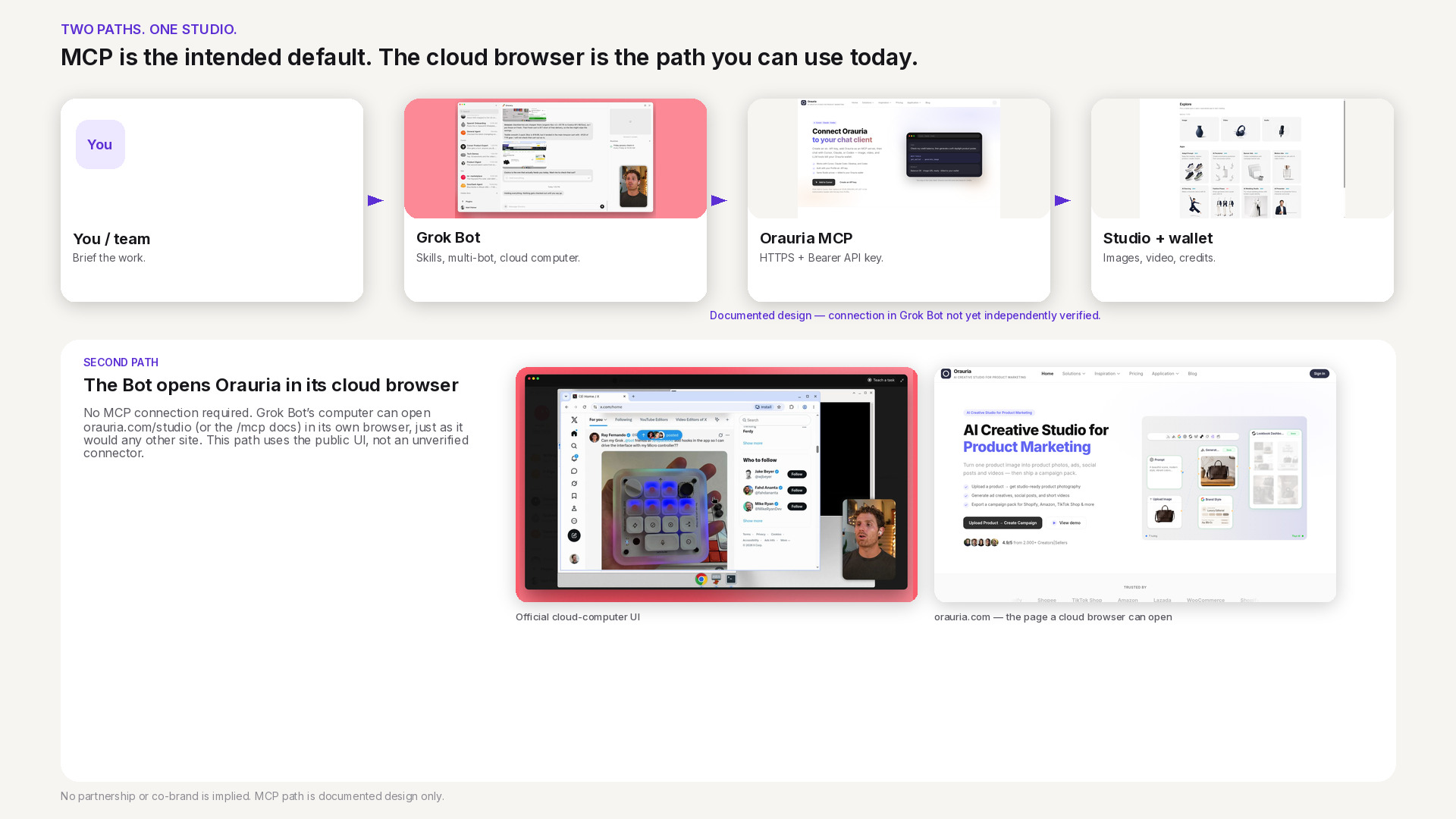
    Facts about Grok Bot come from public pages on x.ai/bot and docs.x.ai, including the documentation on skills and routines and the cloud computer and apps (updated 11 November 2026). We checked those sources on 12 November 2026 (Asia/Saigon, UTC+7). We have not independently run this exact repurposing workflow end to end inside Grok Bot. Postiz is described from its official Grok Bot plugin path, as in the earlier posting-routine article, and has not been end-to-end tested in this run. Connecting Orauria as an MCP server inside Grok Bot is documented design, not an independently verified recipe; Orauria’s public /mcp page lists Cursor, Claude, and Codex, and does not list Grok Bot as a verified client. A practical first path is the Bot’s cloud browser, after you have signed in yourself.

    Key takeaways. A useful repurposing loop is not a Bot that pastes the same blog paragraph into four caption boxes and offers to “just post it.” It is a short, named skill that reads one canonical URL or file, writes platform-specific drafts a stranger could actually publish, requests or files a visual for each item, and stops before anything is scheduled. Official docs describe a persistent cloud computer with a browser, files, and a command line, plus scheduled routines that keep running while your laptop is closed. Orauria is the creative layer for stills and carousels; Postiz is the queue, and only after you approve the pack. Effectiveness is not a promised lift in reach. It is what you measure on your own pack: coverage across the four channels, on-voice accuracy, invent-nothing discipline, visual completeness, review time, and zero unapproved publishes. The Bot prepares. You still decide what goes out.

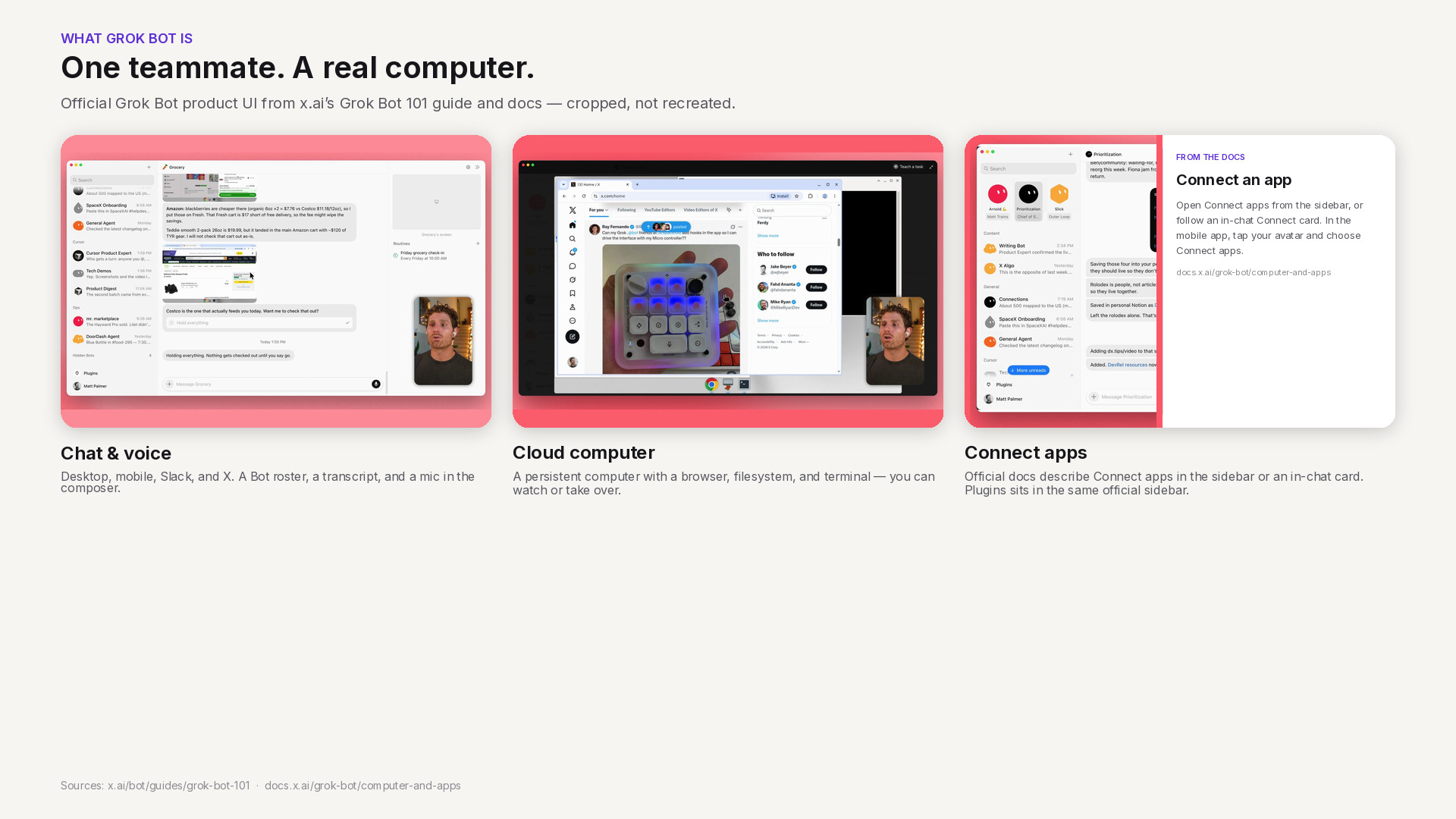
    The same woman looks at a laptop and a small stack of blank pages on the desk. The screen shows the real Grok Bot chat. Hook text: The post is done. The channels are empty.

    The Friday feeling of a finished article and four empty channels

    Meet An. She is not a real client. She is an illustrative content lead in her early thirties, working at a small home-and-living brand that already publishes a careful blog. What still wears her down is Friday at 4:30 p.m. The article is live. The CMS tab is green. And the four channels that are supposed to carry the same idea — Facebook, Instagram, TikTok, and X — are empty. A designer is waiting on a square crop that does not exist. A manager will ask, on Monday, why the post “didn’t get any support.” An can feel the familiar tightness in her chest: she will either stay late and improvise four captions that all sound like the same paragraph, or she will promise herself she will do it on Sunday night, which is how last month’s article never got a single follow-up post.

    That feeling is not a lack of ideas. It is the specific fatigue of doing a careful job twice, with tools that do not share a method. An is good at the article. She is tired of rediscovering, every Friday, how a Facebook post, an Instagram carousel, a TikTok hook, and an X thread are not the same object. The “after” we want is quieter. Monday morning she opens a short pack that was waiting for her: one Facebook post with a clear first line and a link, an Instagram caption plus a slide outline, a TikTok hook with a three-beat spoken script, two X posts that do not invent a statistic, and a visual brief or an Orauria still sitting next to each item. Nothing has been scheduled. Nothing has been published. Her shoulders drop a little. She still owns the approve button, but she no longer has to rebuild the pack from a blank caption box before she can use it. Your brand will not be hers. The feeling you want — a pack instead of four empty channels — is available.

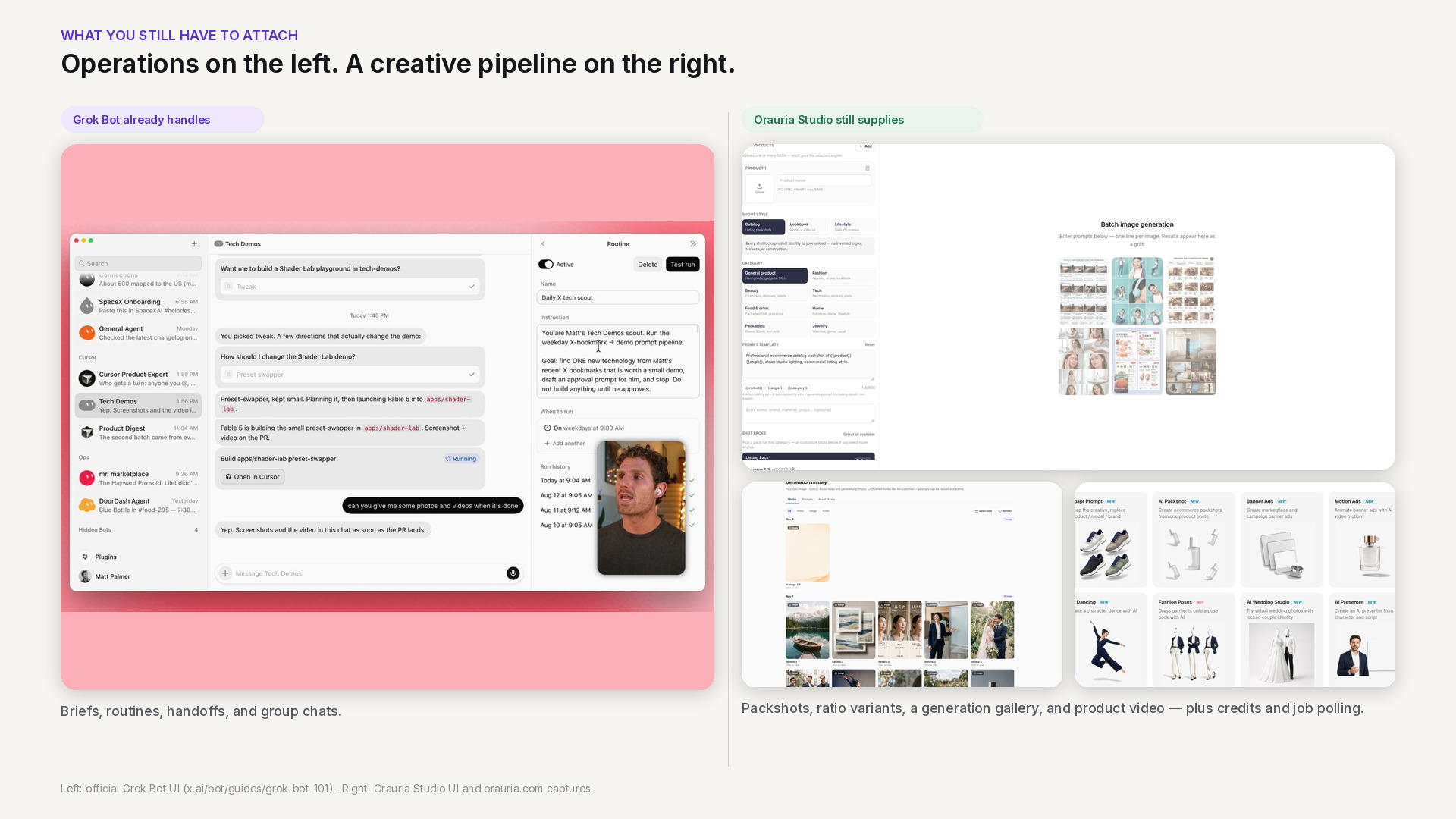
    The same woman sits with a blank open notebook beside a laptop showing the real Grok Bot interface. Hook text: Measure the pack, not the word count.

    What effectiveness looks like, and how to measure your own pack

    It is tempting to judge a repurposing routine by how many captions it produced, or by a promised jump in impressions. If the Bot invents a “five times more engagement” line, copies the same paragraph into four boxes, or schedules a draft you have not seen, volume is a bad scoreboard. We will not invent a percentage improvement and pretend it came from a real brand. In this workflow, effectiveness is closer to a trustworthy pack than to a vanity metric. You can start measuring this week, in a notebook or a sheet, with five questions.

    • Pack coverage. Of the four channels you asked for, how many items actually arrived as a finished draft — and how many were an explicit, dated skip rather than a silent gap?
    • On-voice accuracy. When you reread the source article, how many claims, names, prices, and links in the pack can you point back to a sentence on the page? How many were softened, swapped, or invented?
    • Platform fit. Did each item respect the job of that channel — length, hook, CTA, and format — or did you receive the same paragraph four times with a different heading?
    • Visual completeness. Does every item have a real asset, a named Orauria output, or a brief specific enough to produce one? How often did the pack say only “add an image later”?
    • Time to an approved pack, and unapproved sends. Once the drafts are waiting, how many minutes do you still spend correcting, cutting, and deciding — and did anything get scheduled or published before you said yes to that exact item?

    An’s illustrative target — you should replace it with your own — looks like this. Before the system, a typical Friday might mean one exhausted Facebook paste, three empty channels, and a Monday question she cannot answer. After a few iterations, a “healthy” run might be: a pack waiting before the week opens, all four channels drafted or deliberately skipped, no invented numbers, a visual attached or briefed for each item, and a Postiz queue that is still empty until she approves. If a week goes badly, the record should tell you whether the problem was a vague brief, a source the Bot did not actually open, a template so loose that every caption sounded like a blog intro, a visual that never arrived, or a habit of letting the plugin schedule “to be helpful.” That is more useful than a screenshot of a long chat that merely looks busy.

    There is one more honesty rule. Do not let the Bot congratulate you with a made-up reach forecast or a count of hours saved. Ask it to report which URL or file it read, which claims it reused, which it refused to invent, which visuals are ready, and what is still waiting for your approval. The feeling of effectiveness is not “the machine posted for us.” It is “the pack is complete, the claims are ours, and the next click is still mine.”

    The same woman watches a laptop screen showing the real Grok Bot routines panel. Hook text: The Bot drafts. You still approve.

    How the loop works: a skill, Orauria for visuals, Postiz for the queue, and a human in the loop

    Under the hood, this is still a small agent loop, not an autonomous social team. You give the Bot a method. It uses tools. It leaves a pack where you can find it. Only then — and only if you choose — does an item move into a scheduler, and only then do you, or a person you designate, press the last approval. You do that part.

    Grok Bot is an AI teammate with a persistent cloud computer that has a browser, files, and a terminal, so work can continue after you close your laptop. Official documentation describes two pieces that fit this job. A skill is a reusable set of instructions: when to use it, required inputs, the steps, how to check the result, what to return, and what needs your approval. A routine tells one Bot when to run that work — on a schedule, or when an event happens. Routines run in the cloud while your laptop is closed. The same documentation page states hourly limits: all of your routines together can run up to 300 times an hour, and each routine up to 200 times an hour. A weekly repurposing run does not need to approach those limits. Official docs also say a Bot can own up to 50 routines, that schedules must be at least five minutes apart, and that a new routine waits for its next scheduled time rather than running at the moment you create it. Use Test when you want a run now, and remember that a test performs real work.

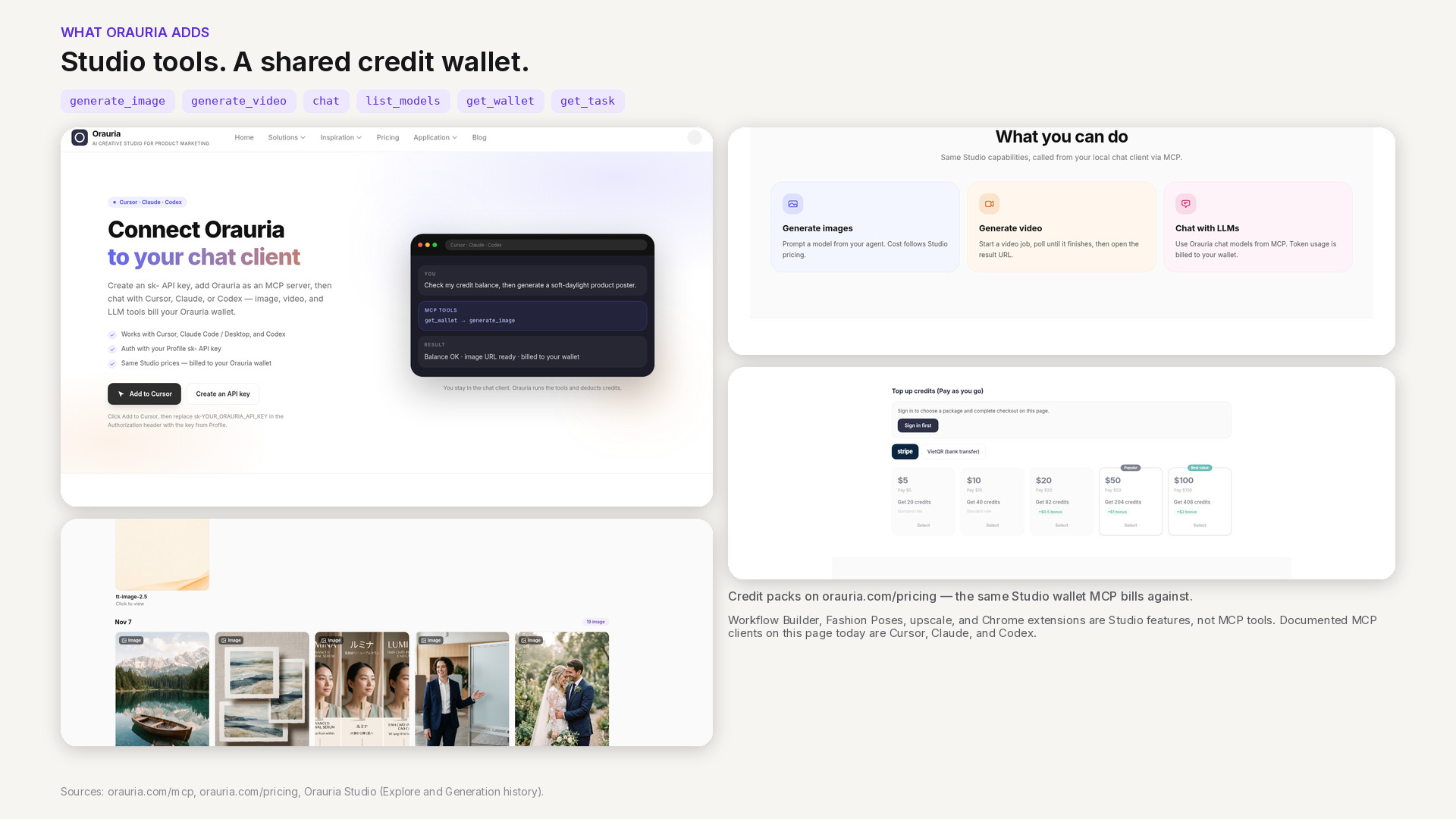
    For this use case, the practical tools are ordinary, and two of them need an honest label. The Bot’s cloud browser can open a public article URL you provide, or it can read a draft you saved under /workspace. It can write the pack as a dated folder of text files, or as a single brief you can review in the chat. Orauria is the layer we already sketched in What Grok Bot Is, and How Orauria Extends It for Product Creative: stills, carousels, and other product-creative outputs that match the article. A first, conservative path is to open Orauria in the Bot’s cloud browser after you have signed in yourself. Official docs are clear that when a site puts up a login, a passkey, a CAPTCHA, or a human check, the Bot should pause and hand the computer to you rather than invent a workaround, and you should never paste passwords or one-time codes into ordinary chat. Connecting Orauria through MCP inside Grok Bot is documented design, not something we have independently verified in this run, so treat that path as a test to perform, not as a finished recipe. Postiz remains the official plugin path described in the earlier weekly social-posting routine. We have not end-to-end tested Postiz in this run. The hard rule does not depend on that test: the skill must not schedule or publish anything until you approve the exact item. A queue you have not reviewed is not a queue. It is a risk.

    Two boundaries matter more than the tools. First, the pack must not invent. If the article does not contain a statistic, a discount, a testimonial, or a “best in the market” claim, the caption must not grow one. If a product name, a price, or a URL is ambiguous, the skill should quote the source, flag the uncertainty, and stop. Second, because the cloud computer — files, logins, and browser sessions — is shared by every Bot on your account, do not leave social-network passwords, ads-manager sessions, or API keys in the pack folder. Use a secret card, a Connect flow, or Vault for anything that should stay private. A Postiz key belongs in that private path, not in ordinary chat.

    The official docs also describe Teach a task: when the control is available, you can demonstrate a browser workflow for up to ten minutes and review the skill the Bot drafts. That capability may be enabled gradually. If you do not see it, write the steps yourself from one successful manual run. Either way, the learned or written skill is a draft until you add failure handling and a hard rule: never invent a claim, never attach the wrong product image, and never schedule or publish to a channel without your explicit approval on that item.

    Context and memory follow the same logic as the rest of this series. Do not expect the Bot to “remember” last month’s brand voice from a long chat. Durable rules live in the skill: the audience, the words you will not say, the CTA pattern, the channels in the pack, and the approval gate. The week’s evidence lives in a dated folder: source URL, claims reused, claims refused, drafts by channel, visual files or briefs, and a status such as drafted, needs review, approved, scheduled, or skipped. The Monday pack is a contract you can read in a few minutes: what is ready, what is missing, and what still needs you.

    The same woman reviews a single blank sheet beside a laptop showing the real Grok Bot settings panel. Hook text: Start with one URL. Review the pack.

    Setup experience: from one URL to the first approved pack

    The first setup is not a five-minute trick. It is a careful afternoon, and the reward is that you name the job once and then improve the skill, instead of improvising four captions every Friday.

    1. Pick one canonical post and write the pack brief, not a vague mood. Choose a single published URL, or a finished draft already in /workspace. Beside it, write the audience, the one action you want, the claims you will not invent, and the four channels you want this week. “Make this article go viral on social” is not a brief. “This URL, these four channels, this CTA, no new statistics” is a brief. Start narrower than you think. One article you can verify is more valuable than a backlog you will never audit.

    2. Run the method once, in front of you, before you create a routine. Give the Bot the URL and a first version of the skill. Ask it to open the public page — or to read the file — and to draft one item per channel, each with a hook, a body, a CTA, and a note about the visual it needs. Sit with the computer preview open, as the official docs describe, so you can watch it read the source rather than hoping the chat is enough. If a site asks for a login or shows a CAPTCHA, take over for that step, or save a clean local copy of the article and point the Bot at the file. Never paste a password into the chat to “just finish the pack.”

    3. Save a skill a stranger could follow. After one clean run, ask the Bot to save the method as a skill. It should say when to use it, what inputs it needs, the order of work, how to check every claim against the source, what each channel’s draft should look like, how visuals are requested or filed, and what requires your approval. Put the hard rules in writing. Do not invent a statistic, a discount, a testimonial, or a ranking. Do not paste the same paragraph into four boxes and call it a pack. Quote the source, keep the URL, and flag uncertainty. If the page will not load, say so and stop. Do not schedule, publish, or send a customer-facing message unless you approve that exact item.

    4. Make the visual path real, then stop for approval. For each draft, the pack should hold either a finished still or a brief specific enough to produce one: aspect ratio, subject, text that must not be invented on the image, and the product or scene that must appear. If you use Orauria in the cloud browser, sign in yourself when the login appears, and watch the first image come back. If you later test an MCP connection, treat the first run as a test: confirm the Bot can request only what you intended, and that it still stops before anything is scheduled. Official docs are clear that connected apps and the cloud computer are account-wide. Creative logins do not belong in the pack folder.

    5. Only then involve Postiz, in the right time zone, and only after you approve the pack. The earlier article on a weekly posting routine with Postiz is the queue layer. In this use case, Postiz should see items only after you have approved the copy and the visual. Open the routine — if you attach one — and check When to run, which official docs say shows the saved schedule in words, in the time zone under Settings, Bot, Timezone. If it does not match what you meant, edit it. A new routine will not run at creation; use Test once on a safe pack, then let the next scheduled slot be the first real run. Keep the cadence slow. You do not need a new pack every hour. You need a Monday morning set you will actually read.

    Pitfalls you will see in the first week (and the ones this illustrative run shows An). The brief was a mood, not a URL, so the Bot summarized a different article. Four captions arrived as the same paragraph with four headings. A “3x more durable” line appeared that was not in the source. The visual was a generic lifestyle crop with a misspelled word on the image. The Bot offered to “just schedule it in Postiz.” The time zone followed a laptop set to the wrong zone, and a test post landed on a Sunday afternoon. Someone suggested pasting a social login into the chat when a page asked for a human. A second Bot on the same account could see the folder. The Monday message was a wall of prose she would not read on a phone. None of these is a reason to quit. They are reasons to tighten the skill, which the next section does on purpose.

    The same woman looks slightly resolved at a laptop showing the real Grok Bot cloud computer. A tidy stack of blank pages sits on the desk. Hook text: V1 pasted the blog. V3 ships a pack.

    The optimization journey: three versions of the same repurposing run

    If the first week is disappointing, that is normal. The pack is a process you revise. Here is an illustrative v1 → v2 → v3, using An’s Friday as the example. The wording will be different for you. What matters is the shape of the revision.

    Version 1 — “Just turn this blog into social posts.” The prompt is short and ambitious. The Bot opens something that looks related, pastes a fluent paragraph into the chat four times, and offers to “get it live today.” A statistic that was never in the article appears in the TikTok hook. The Instagram caption is the blog’s introduction with emoji. There is no visual, only a note to “add a pretty image.” After v1, An’s feeling is a familiar irritation. Faster than a blank box, maybe, but she cannot defend a line if a customer asks where it came from, and she does not want the Bot anywhere near the scheduler. Measured honestly, coverage is sloppy, and the pack is not something she can approve.

    Version 2 — There are channel templates, but the pack is still messy. An gives the Bot the exact URL and asks for four distinct shapes: a Facebook post with a link, an Instagram carousel caption, a short TikTok script, and two X posts. A week improves. The Bot no longer wanders into a different article. The skill now says it must wait for approval before scheduling. New problems show up. The claims are mostly accurate, but one caption still upgrades “durable” into “the most durable in its class.” The visuals arrive late, or as a single square used four times, including on a TikTok item that needed a vertical frame. A test in Postiz is left “ready to publish” because someone assumed approval had already happened. Review time shrinks, then grows again, because she is still the person stitching the pack back together by hand.

    Version 3 — A skill, a claims check, a visual for each item, and a queue that waits. Each run now reads a named URL or file and writes to a named folder. A caption is only “ready” if every claim can be pointed back to the source, the channel shape is right, and a visual exists or is briefed with an aspect ratio. If the page will not load, or a claim cannot be verified, the item is marked as such and no sentence is invented. The Monday message is short: four items, what was refused, which visuals are attached, and a reminder that nothing was scheduled. In this illustrative v3 week, An reads the pack with coffee, cuts one adjective, swaps one still, approves three items, and leaves TikTok for a reshoot. “Optimization” here is that: fewer surprises, a shorter review, and a pack that is still hers.

    When you revise, change one constraint at a time and keep a dated copy of the skill. The earlier articles in this series are the same discipline in other jobs — a posting routine, a job filter, a research method, a small Bot team, a weekday price watch. If you want a tighter skill, a tested Orauria connection, or a Bot that builds a pack around a catalog you already trust and still stops for your approval, you can hire Orauria to build it.

    What to try this week

    You do not need to empty a backlog. Pick one published article, write the audience and the claims you will not invent, and run the method once while you watch the computer. Save a skill that forbids new statistics and forbids scheduling or publishing without your approval. Measure coverage, invented claims, visual gaps, and review time on one pack. Then write v2: a distinct shape for each of the four channels, a visual brief or an Orauria still per item, and a Postiz queue that stays empty until you say yes. Only then consider a slower weekly routine in the time zone where you actually start the week. If the loop needs a sharper skill, a tested connection, or a Bot built around your brand voice and your approval rules, send a brief to hire Orauria.

    Use Grok Bot for the teammate layer: the source, the pack, the first drafts, the visual requests. Use Orauria for the stills and carousels. Use Postiz for the queue, after you approve. Keep the last publish with a person. The Friday afternoon gets lighter when the pack is already waiting, and you can still say no.


  • How to Monitor Competitor Prices and Stock Every Day with a Grok Bot Routine

    How to Monitor Competitor Prices and Stock Every Day with a Grok Bot Routine

    This article is part of a practical Grok Bot series that began with 7 Grok Bot Tips to Schedule Posts, Filter Upwork Jobs, and Research Faster and continued through a weekly social-posting routine with Postiz, an Upwork job filter with human-reviewed proposal drafts, a research workflow that turns sources and verification into a skill, and a multi-bot team extended with Orauria. This piece goes deeper on one everyday operations job: watching competitor prices and public stock signals on a weekday routine, then leaving you a brief you can act on. It is written as an illustrative week, not a client case study, and it does not claim an official partnership with xAI or Grok Bot.

    Facts about Grok Bot come from public pages on x.ai/bot and docs.x.ai, including the documentation on skills and routines and the cloud computer and apps (updated 11 November 2026). We checked those sources on 12 November 2026 (Asia/Saigon, UTC+7). We have not independently run this exact competitor-watch workflow end to end inside Grok Bot.

    Key takeaways. A useful price-and-stock watch is not a Bot that refreshes five product tabs while you stand at the counter. It is a short, named skill, a weekday routine in your time zone, a durable table of what changed, and a rule that the Bot never invents a price when a page will not load. Official docs describe a persistent cloud computer with a browser, files, and a command line, plus scheduled routines that keep running while your laptop is closed. Google Sheets is a documented Connect app if you want the table off the computer; a file in /workspace is enough to start. Effectiveness is not a promised number of hours saved. It is what you measure on your own watch list: coverage, failed pages, true changes caught, false alarms, and the minutes it takes you to read a brief you trust. The Bot prepares. You still decide whether a price on your own shop moves.

    The same woman looks weary at the laptop, with a small stack of printed pages on the desk. The screen shows the real Grok Bot chat comparing prices. Hook text: The same five pages every morning.

    The morning feeling of checking the same five product pages

    Meet Mai. She is not a real client. She is an illustrative owner of a small home-goods shop, in her late thirties, who already knows her bestsellers by touch. What still wears her down is the half hour before the shutter goes up. At 7:40 a.m., the feeling is familiar: a tight jaw, a phone in one hand, five competitor product pages open, and a notebook where yesterday’s prices are already a little smudged. One rival has a sale badge that was not there on Tuesday. Another page says “only a few left,” which might be true and might be theatre. A third site is slow, and she is not sure whether the price changed or she is looking at the wrong pack size. A customer will ask, in less than an hour, why a nearby shop is cheaper on the same ceramic set. Mai does not want a speech. She wants to know whether the change is real.

    That feeling is not laziness. It is the specific fatigue of doing a careful job with a tool that cannot remember yesterday. Mai is good at deciding. She is tired of re-collecting the evidence. The “after” we want is quieter. Mid-morning, she opens a short brief that was waiting for her: twelve URLs on the watch list, ten checked, one site blocked, one page no longer found, and three material changes with the old price, the new price, the captured time, and a link she can reopen. Nothing on her own shop has moved. The Bot has not messaged a supplier or updated a listing. Her shoulders drop a little. She still owns the next decision, but she no longer has to rebuild the table from memory before she makes it. Your catalog will not be hers. The feeling you want — a brief instead of five anxious tabs — is available.

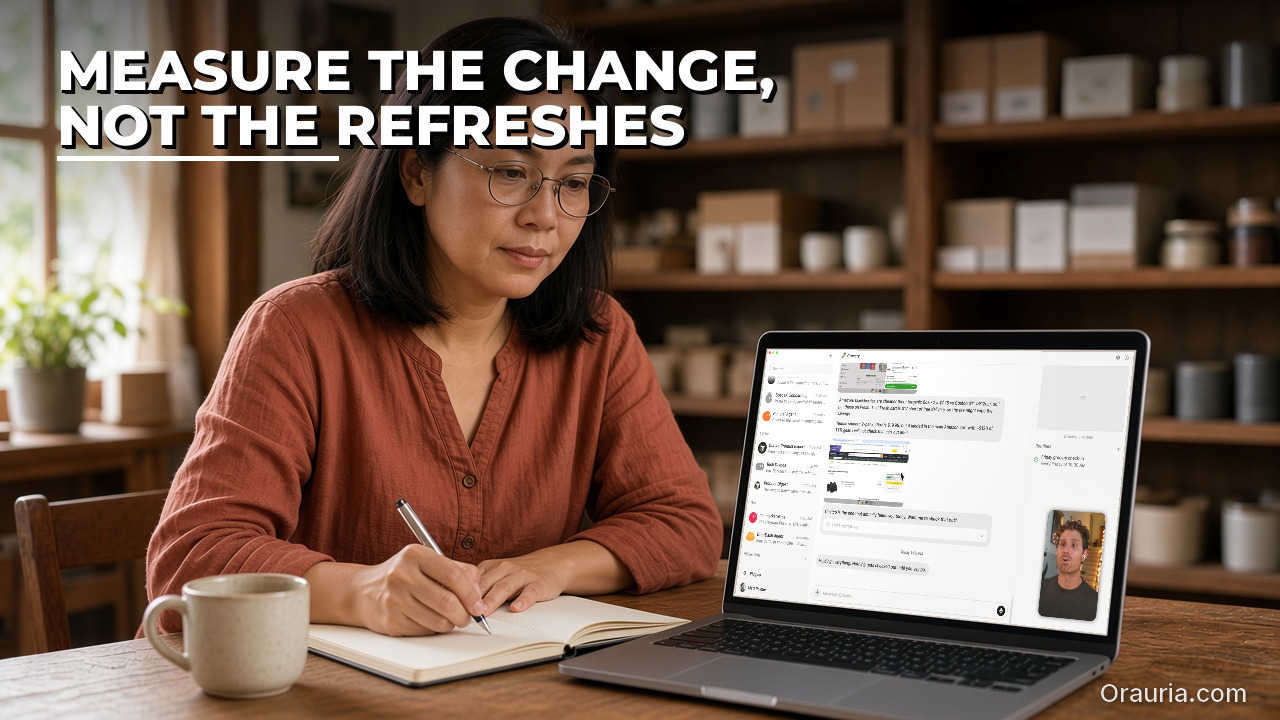
    The same woman calmly writes a table in a notebook beside a laptop showing the real Grok Bot interface. Hook text: Measure the change, not the refreshes.

    What effectiveness looks like, and how to measure your own watch list

    It is tempting to judge a monitoring routine by how early it finishes, or by a promised number of hours returned to the shop floor. If the Bot invents a price, misses a pack-size change, or treats a stuck page as “no change,” speed is a bad scoreboard. We will not invent a percentage improvement and pretend it came from a real store. In this workflow, effectiveness is closer to a trustworthy brief than to a stopwatch. You can start measuring this week, in a notebook or a sheet, with five questions.

    • Coverage. Of the SKUs and URLs on today’s watch list, how many were actually opened and recorded?
    • Failed or stale pages. How often did a page 404, fail to load, show a login or a CAPTCHA, or disagree with a pack size or currency you already recorded?
    • True changes caught. When you later reopen a sample of pages yourself, how many real price or public stock changes did the brief include — and how many did it miss?
    • False alarms. How many “changes” were really a shipping note, a crossed-out list price, a different colorway, or a temporary badge the Bot treated as a new selling price?
    • Time to a usable brief. Once the routine has run, how many minutes do you still spend checking, correcting, and deciding — and did the Bot stay stopped until you said so?

    Mai’s illustrative target — you should replace it with your own — looks like this. Before the system, a typical morning might mean five hurried tabs, a missed sale on Thursday, and a price she only noticed because a customer mentioned it. After a few iterations, a “healthy” run might be: a brief waiting before she opens, nearly every URL checked, failures listed instead of guessed, only material changes highlighted, and no listing on her own shop touched. If a morning goes badly, the record should tell you whether the problem was a vague watch list, a page the Bot could not read, a threshold so tight that every badge looked like a crisis, or a habit of trusting a fluent sentence without reopening the link. That is more useful than a screenshot of a long chat that merely looks busy.

    There is one more honesty rule. Do not let the Bot congratulate you with a made-up “market index” or a count of hours saved. Ask it to report which URLs it opened, which prices and public stock phrases it recorded, what it could not verify, and what is waiting for you. The feeling of effectiveness is not “the machine repriced the shop.” It is “the change is visible, and the next click is still mine.”

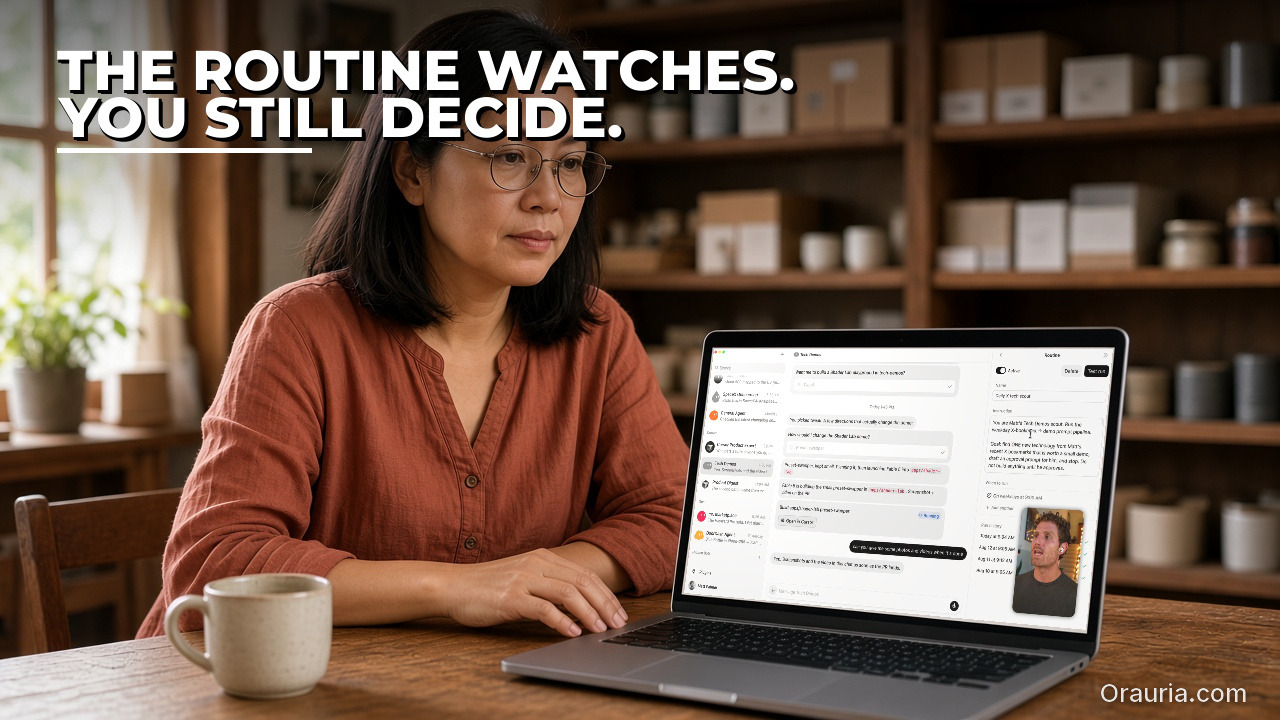
    The same woman watches a laptop screen showing the real Grok Bot routines panel. Hook text: The routine watches. You still decide.

    How the loop works: a skill, a scheduled routine, and a human in the loop

    Under the hood, this is still a small agent loop, not a fully autonomous pricing department. You give the Bot a method. It uses tools. It leaves work where you can find it. Only then — and only if you choose — does a price on your own channels move. You do that part.

    Grok Bot is an AI teammate with a persistent cloud computer that has a browser, files, and a terminal, so work can continue after you close your laptop. Official documentation describes two pieces that fit this job. A skill is a reusable set of instructions: when to use it, required inputs, the steps, how to check the result, what to return, and what needs your approval. A routine tells one Bot when to run that work — on a schedule, or when an event happens. Routines run in the cloud while your laptop is closed. The same documentation page states hourly limits: all of your routines together can run up to 300 times an hour, and each routine up to 200 times an hour. A weekday morning watch does not need to approach those limits. Official docs also say a Bot can own up to 50 routines, that schedules must be at least five minutes apart, and that a new routine waits for its next scheduled time rather than running at the moment you create it. Use Test when you want a run now, and remember that a test performs real work.

    For this use case, the practical tools are ordinary. The Bot’s cloud browser can open public product pages on a list you provide. It can record what it finds in a file under /workspace, or, if you have connected it, in Google Sheets, which official docs describe as a Connect app that can read and edit cells the authorized Google account can already edit. Finding files in Drive uses the Google Drive app. We have not independently verified a Sheets connection inside Grok Bot in this run, so treat that path as documented design to test, not as a finished recipe. A local sheet in the shared workspace is a sound first version. Because the cloud computer — files, logins, and browser sessions — is shared by every Bot on your account, do not leave marketplace passwords, payment logins, or API keys in that folder. Use a secret card, a Connect flow, or Vault for anything that should stay private.

    Two boundaries matter more than the tools. First, this workflow should stick to pages that are public. Official docs are clear that when a site puts up a login, a passkey, a CAPTCHA, or a human check, the Bot should pause and hand the computer to you rather than invent a workaround, and you should never paste passwords or one-time codes into ordinary chat. A competitor-watch skill should say the same in writing: if a page will not load, record the failure and stop. Do not create accounts to get behind a wall, and do not ask the Bot to bypass a block. Second, public “stock” language is only a signal. “In stock,” “only three left,” or a disappeared buy button can be true, stale, or theatrical. The brief should quote what the page said, with a time, and leave the judgment to you.

    The official docs also describe Teach a task: when the control is available, you can demonstrate a browser workflow for up to ten minutes and review the skill the Bot drafts. That capability may be enabled gradually. If you do not see it, write the steps yourself from one successful manual run. Either way, the learned or written skill is a draft until you add failure handling and a hard rule: never change your own listings, never contact a supplier, and never send a customer-facing message without your explicit approval on that item.

    Context and memory follow the same logic as the rest of this series. Do not expect the Bot to “remember” last month’s prices from a long chat. Durable rules live in the skill. The week’s evidence lives in a dated table: URL, SKU or product name, pack size, currency, previous price, new price, public stock phrase, time captured, and a status such as checked, blocked, missing, or needs review. The morning brief is a contract you can read in a few minutes: what changed enough to care about, what failed, and what still needs you.

    The same woman writes a Watch List in a notebook: name each URL, write the pack size, review once. The laptop shows the real Grok Bot settings panel. Hook text: Write the list. Run it once.

    Setup experience: from a watch list to the first morning brief

    The first setup is not a five-minute trick. It is a careful morning, and the reward is that you name the job once and then improve the skill, instead of improvising the five tabs every day.

    1. Write a watch list, not a vague category. On paper or in a sheet, list the exact product pages you care about this month. A useful row has a URL, the name you use in your shop, the pack size or variant that must match, and the currency you expect. “Watch ceramics on the market” is not a list. Twelve URLs you can reopen by hand is a list. Start narrower than you think. A short list you can verify is more valuable than fifty links you will never audit.

    2. Run the method once, in front of you, before you create a routine. Give the Bot the list and a first version of the skill. Ask it to open each public page, record price and any public stock phrase, and compare the result with yesterday’s table — or with a baseline you type in today. Sit with the computer preview open, as the official docs describe, so you can watch navigation rather than hoping the chat is enough. If a site asks for a login or shows a CAPTCHA, take over for that step or, better for this job, skip the page and have the Bot record that it could not read it. Never paste a password into the chat to “just finish the list.”

    3. Save a skill a stranger could follow. After one clean run, ask the Bot to save the method as a skill. It should say when to use it, what inputs it needs, the order of work, how to validate a row, what the brief should look like, and what requires your approval. Put the hard rules in writing. Do not invent a price, a discount, or a stock count. Do not treat a list price and a selling price as the same thing. Quote the page, keep the URL and the time, and flag uncertainty. If the page is gone, blocked, or ambiguous, say so and stop. Do not update your own shop, send email, or post to a channel unless you approve that exact item.

    4. Only then attach a routine, in the right time zone. Ask the Bot that should own the job to run the skill on weekday mornings, at a time that is early for you and late enough that most product pages have settled. Official docs say schedules use the time zone in Settings, under Bot, labeled Timezone, and that you should open the routine and check When to run, which shows the saved schedule in words. If it does not match what you meant, edit it. A new routine will not run at creation; use Test once on a safe list, then let the next weekday be the first real morning. Keep the cadence slow. You do not need a check every five minutes. You need a brief you will actually read.

    5. Decide where the table lives, and keep secrets off the shared computer. A dated file in /workspace is enough. If you later connect Google Sheets, treat the first connection as a test: confirm the Bot can edit only the sheet you intended, and that it still stops before changing anything in your selling channels. Official docs are clear that connected apps are account-wide, and that the cloud computer is shared across your Bots. Marketplace logins, ads-manager sessions, and payment credentials do not belong in the watch-list folder.

    Pitfalls you will see in the first week (and the ones this illustrative run shows Mai). The list was a category, not URLs, so the Bot compared the wrong variant. A sale badge was recorded as the new regular price. A blocked page was summarized as “unchanged.” The time zone was wrong, and the brief arrived after she had already opened the shop. The routine tried to be helpful and drafted a price change for her own listing. Someone suggested pasting a login into the chat when a site asked for a human. A second Bot on the same account could see the file. The morning message was a wall of prose she would not read on a phone. None of these is a reason to quit. They are reasons to tighten the skill, which the next section does on purpose.

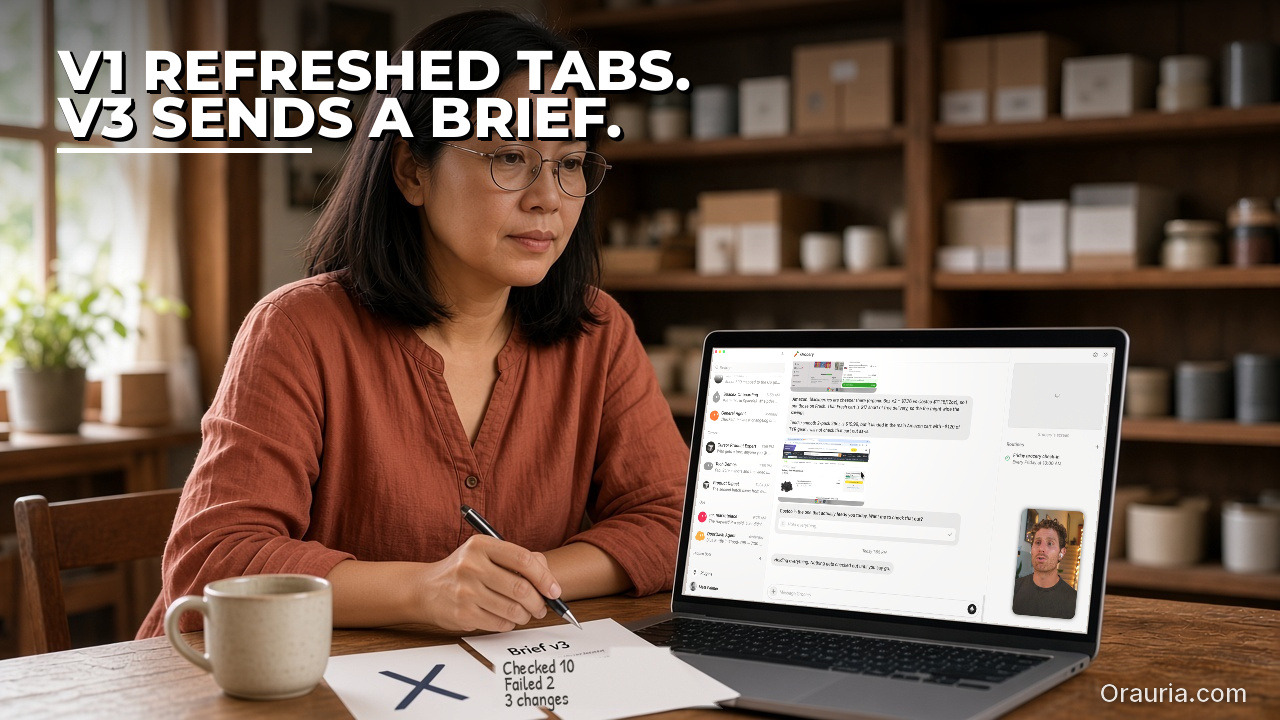
    The same woman works beside a page marked with a large X and a Brief v3 sheet. The laptop shows the real Grok Bot interface. Hook text: V1 refreshed tabs. V3 sends a brief.

    The optimization journey: three versions of the same price watch

    If the first week is disappointing, that is normal. The watch is a process you revise. Here is an illustrative v1 → v2 → v3, using Mai’s shop as the example. The wording will be different for you. What matters is the shape of the revision.

    Version 1 — “Just check the competitors every morning.” The prompt is short and ambitious. The Bot opens a few pages it considers similar, pastes a fluent paragraph into the chat, and offers to “keep her prices competitive.” Yesterday’s ceramic set gets compared with a different pack size. A page that did not load is skipped in silence. After v1, Mai’s feeling is a familiar irritation. Faster than five tabs, maybe, but she cannot defend a number if a customer asks, and she does not want the Bot anywhere near her own listings. Measured honestly, coverage is uneven, and the brief is not a table she can audit.

    Version 2 — There is a list, but the table is still messy. Mai gives the Bot exact URLs and asks for a spreadsheet. A week improves. The Bot no longer wanders off into a vaguely related product. The routine at least waits for her approval before touching her shop, because the skill now says so. New problems show up. Every tiny badge looks like a change, so the brief is noisy. Failures are still sometimes written as “no change.” The first scheduled run is late because the time zone followed a laptop that was set to the wrong zone. Two colorways share a confusing title, and one row overwrites the other. Review time shrinks, then grows again, because she is now the person stitching the table back together by hand.

    Version 3 — A skill, a change threshold, a failure policy, and a short brief. Each run now reads a named list and writes to a named file or sheet. A change is only “material” if the selling price moved by a threshold she chose, or if the public stock phrase crossed a line she defined — for example from in stock to unavailable — and the pack size still matches. If a page is blocked, missing, or ambiguous, the row is marked as such and no number is invented. The morning message is short: checked, failed, material changes, links, times, and a reminder that her own listings were not touched. In this illustrative v3 week, Mai reads the brief with coffee, reopens two links, ignores a noisy badge the skill correctly left out, and changes nothing until she has walked the shop floor. “Optimization” here is that: fewer surprises, a shorter review, and a watch that is still hers.

    When you revise, change one constraint at a time and keep a dated copy of the skill. The earlier articles in this series are the same discipline in other jobs — a posting routine, a job filter, a research method, a small Bot team. The creative layer, if a price change later needs new product images, is the layer we sketched in What Grok Bot Is, and How Orauria Extends It for Product Creative. If you want a connector, a tighter skill, or a Bot that watches a catalog you already trust and still stops for your approval, you can hire Orauria to build it.

    What to try this week

    You do not need to watch an entire market. Pick eight to twelve public product pages, write the pack size and currency beside each URL, and run the method once while you watch the computer. Save a skill that forbids invented prices and forbids touching your own listings. Measure coverage, failures, and false alarms on one week of briefs. Then write v2: a material-change threshold, a failure column, and a weekday routine in the time zone where you actually open the shop. Only then consider a slower second pass, or a short alert in a chat you already read, for changes above a higher bar. If the loop needs a sharper skill, a tested Sheets connection, or a Bot built around your catalog and your approval rules, send a brief to hire Orauria.

    Use Grok Bot for the teammate layer: the list, the weekday run, the table, the first brief. Keep the last price change on your own shop with a person. The morning gets lighter when the evidence is already waiting, and you can still say no.
  • How to Build a Multi-Bot Team in Grok Bot and Extend It with Orauria

    How to Build a Multi-Bot Team in Grok Bot and Extend It with Orauria

    This is the last article in a five-part series that began with 7 Grok Bot Tips to Schedule Posts, Filter Upwork Jobs, and Research Faster. The earlier deep dives covered a weekly social-posting routine with Postiz, an Upwork job filter with human-reviewed proposal drafts, and a research workflow that turns sources and verification into a skill. This capstone puts those jobs on a small Bot team, and extends the team when you need product creative — written as an illustrative week, not as a client case study, and without any claim of official partnership with xAI or Grok Bot.

    Facts about Grok Bot come from public pages on x.ai/bot and docs.x.ai, including the documentation on skills and routines and the cloud computer and apps (updated 11 November 2026). Facts about Orauria’s MCP tools come from orauria.com/mcp. We checked those sources on 12 November 2026 (Asia/Saigon, UTC+7).

    Key takeaways. A useful multi-bot setup is not “one chat that does everything.” It is a few named Bots, each with a narrow job, a written handoff, and a person who still approves what leaves the studio. The official docs are clear that the cloud computer — files, sign-ins, and browser sessions — is shared across every Bot on your account, so secrets do not belong in a shared folder. Effectiveness is something you measure on your own team: failed handoffs, review time, rework when the wrong Bot touched a job, and how long an approved brief takes to become a reviewed image — not a promised lift in output. Product creative is a different layer. Today you can open Orauria Studio in the Bot’s cloud browser. Adding Orauria as a custom Remote HTTPS connector inside Grok Bot is documented design, not an independently verified recipe. The first version of a team is usually one overloaded Bot. The third version is usually the one that holds.

    The same woman looks down at a messy stack of papers on the studio table. Hook text: One chat used to hold everything.

    The morning feeling of one chat that holds everything

    Meet Lan — an illustrative small-team lead, not a real named client. She is in her mid-thirties and runs a small product brand out of a shared studio. The work is real: a weekly calendar, a little research before a launch, the occasional freelance brief, and product images that have to look consistent. The part that drains her is not any one of those jobs. It is the feeling, at 8:30 a.m., that all of them live in a single chat. A caption from last week sits next to a half-checked source. A product photo request is buried under a draft proposal. Someone on the team asks which Bot was supposed to finish the brief, and Lan is not sure she can point to a file and a status without opening five threads.

    The emotion is not a lack of tools. It is the particular fatigue of being the only person who can still see the whole week. Lan is good at deciding. She is tired of retrieving. The after we are aiming for is quieter. Mid-morning, she opens a short digest: the research Bot has left a sourced note waiting for her; the social Bot has queued drafts against approved ideas; the creative Bot has placed two packshot options in a folder, still marked “awaiting review.” Nothing has been published, sent, or spent. She spends half an hour approving, rejecting, and sending one item back. The tightness in her shoulders is gone, replaced by a smaller, sturdier feeling: the team is in motion, and she is still the person who decides what leaves the studio. Your week will not look exactly like hers. The feeling you want — a handoff you can see, not a chat you have to hunt through — can.

    The same woman calmly writes in a notebook at the studio table. Hook text: Measure the handoff, not the noise.

    What effectiveness looks like, and how to measure your own team

    It is tempting to judge a Bot team by how much it “got done,” or by a promised number of hours returned to the studio. Volume is a poor scoreboard if the wrong Bot finished the work, or if an image went out unreviewed. We will not invent a percentage improvement and pretend it came from a real brand. Effectiveness, in this workflow, is closer to operations than to a burst of output. You can start measuring this week, with a notebook or a Sheet, using five questions:

    • Handoff failures. How often did a Bot start from a stale file, a missing brief, or a draft that had not been approved yet?
    • Review time. How many minutes did you, the lead, spend approving, editing, or rejecting, once the Bots had done their first pass?
    • Wrong-Bot rework. How many items had to be redone because the social Bot wrote a research claim, or the research Bot tried to generate an image, or one Bot overwrote another’s folder?
    • Creative cycle time. From an approved brief to a reviewed image sitting in a folder, how long did it take — and how many of those images were sent back?
    • Shared-computer incidents. How often did a secret, a login, or a private file show up somewhere it should not, because the cloud computer is shared?

    Lan’s illustrative targets, which you should replace with your own, look like this. Before the split, a typical week might mean one overloaded chat, two rushed posts, a brief finished late, and a product image that still was not reviewed by Thursday. After a few iterations, a “healthy” week might be a morning digest she can finish in a short coffee, one or two items sent back, zero publishes without her, and a creative handoff that starts only after the brief is marked approved. If a week falls short, the notes tell you whether the problem was an unclear job, a missing handoff status, a Bot reaching into the shared computer, or a habit of skipping review. That is more useful than a screenshot of a busy chat.

    One more rule of honesty: do not let any Bot congratulate you with a made-up productivity forecast. Ask for a short report of what each Bot did, what it could not do, what is waiting on you, and whether it touched a file or a secret it should not have. The feeling of effectiveness is not “the machines ran the studio.” It is “I can see the handoffs, and I still hold the last click.”

    The same woman reviews a page with a pen, still the person who decides. Hook text: Many Bots. One person decides.

    How the loop works: many Bots, a shared computer, and a human in the loop

    Under the hood, this is still a set of small agent loops, not a fully autonomous company. You give each Bot a job and a boundary. It uses tools. It leaves work in a place the next Bot — and you — can find. Then, and only then, something may be scheduled, sent, or exported — by you.

    Grok Bot is an AI teammate with a persistent cloud computer — a browser, files, and a terminal — so work can continue after you close your laptop. Official documentation describes two complementary pieces. A skill is a reusable set of instructions: when to use it, required inputs, the steps, how to check the result, what to return, and what needs your approval. A routine tells one Bot when to run that work, on a schedule or when an event happens. Routines run in the cloud while your laptop is closed. The same docs page (updated 9 November 2026) publishes rate limits: all of your routines together can run up to 300 times an hour, and each routine up to 200 times an hour. A small team of weekly or daily jobs does not need to come close to those limits.

    You can run more than one Bot on the same account, and that is the point of this design: one Bot for research, one for the social queue, one for product creative, perhaps one more later if a job truly splits. Official documentation is equally clear about a consequence that many first teams miss. The cloud computer is shared across every Bot on your account, including files, sign-ins, and browser sessions. Connected apps are account-wide as well. A Postiz key, an Upwork session, or an Orauria token in a file sitting in /workspace is visible in a way you may not intend. Secrets belong in a secret card, a Connect flow, or a plugin prompt — never in the shared research folder, never in Slack, and never in a chat “just this once.”

    Context and memory follow the same logic. A Bot will not reliably “remember the brand” from a long chat last month, and it should not be expected to remember another Bot’s private thread. Put the durable rules in that Bot’s skill. Put the week’s raw material in a folder with a status: draft, approved, waiting on creative, rejected. The handoff is a written contract: what file, what status, what the next Bot may do, and what still needs you. Without that contract, “a team of Bots” is just several chats reaching into the same drawers.

    Product creative is the extension layer, not a replacement for the teammate layer. Orauria is an AI creative studio for product marketing. Its documented MCP tools, listed on orauria.com/mcp, include generate_image, generate_video, chat, list_models, get_wallet, and get_task. Workflow Builder, Fashion Poses, upscale, and Chrome extensions are not MCP tools. As of 12 November 2026, that MCP page documents clients such as Cursor, Claude, and Codex; it does not list Grok Bot as a verified client. Grok Bot’s own docs explain how to add a custom Remote HTTPS connector. In principle, that is the documented way to point a Bot at a remote MCP server, and a reasonable server URL to try is https://orauria.com/api/mcp rather than any http:// example. We have not independently verified that this connection completes inside Grok Bot. Treat a successful connector as something to test, not as a finished how-to. The path you can use today is to open Studio in the Bot’s cloud browser, keep the approval step, and file the results in the same handoff folder.

    The human-in-the-loop step is not a formality, and it becomes more important as the team grows. In this design a Bot may draft, file, and even place work in a queue. It must not publish a post, submit a proposal, spend Connects, or export a campaign visual as final without your explicit confirmation. If you ever feel the system is “so good we can skip review,” that is usually the week a wrong SKU, a stale claim, or an image from the wrong brief would have left the studio.

    The same woman writes a Team Checklist in a notebook: name each job, write the handoff, review once. Hook text: Name the jobs. Draw the lines.

    Setup experience: from one overloaded Bot to a first clean handoff

    The first setup is a morning of careful work, not a five-minute trick. The payoff is that you name the jobs once, then improve the skills and the handoff instead of improvising every week.

    1. Map jobs, not tools. On paper, list the work that actually repeats: for example research, social scheduling, and product creative. Do not start by asking “how many Bots can I create?” Start by asking “which jobs should never share a prompt.” If two jobs need different rules, different approval gates, or different secrets, they probably need different Bots.

    2. Create one narrow Bot per job, with a skill you can read. Give each Bot a plain name — Research, Social, Creative — and a skill that says what it reads, what it writes, where it files, and what it must never do. The social Bot should not invent sources. The research Bot should not publish. The creative Bot should not start from an unapproved brief. Ask each Bot to show you its skill text and save it. Run each one once by hand, on a single item, while you watch.

    3. Write the handoff before you add routines. Create a small set of folders or a Sheet with a status column: inbox, in review, approved, waiting on creative, done, rejected. The contract is boring on purpose. A research note is not “done” until you mark it approved. A social draft may read only from approved ideas. A creative run may read only from approved briefs and a named product. Include the hard rule in every skill: never publish, send, or export as final without explicit approval of the exact item.

    4. Treat the shared computer as a design constraint. Before you connect Postiz, Upwork, Studio, or any other tool, decide where secrets live. Walk through one harmless test: can a second Bot see a file you did not intend to share? If yes, move the secret and tighten the folder names. Then try the creative path you can use today — open Studio in the creative Bot’s browser, generate from an approved brief, and save the result to the handoff folder. If you later try a custom Remote HTTPS connector to Orauria, treat it as a test, and stop if authentication fails. Do not invent a workaround that pastes an API token into a shared file.

    5. Run one full handoff, then consider routines. Pick a single product or a single week. Let the research Bot leave a short sourced note. Approve it. Let the social Bot draft from that note. Approve or reject. Let the creative Bot make one image from the same approved brief. Review it. Only then attach slow routines — for example a weekday morning digest in your timezone. Official docs are clear that routines keep running when your laptop is closed. Set the timezone explicitly. Keep the cadence slow.

    Pitfalls we see in the first week (and that Lan hits in this illustrative run). One mega-Bot was still doing all four jobs under a new name. Two Bots wrote to the same file and overwrote a brief. A secret sat in /workspace and appeared in another Bot’s run. The creative Bot started before the brief was approved. A routine published, or tried to, because “schedule” was left undefined. Someone treated the Orauria connector as a finished recipe. Timezones drifted. The morning digest was a wall of prose she would not read on her phone. None of these are reasons to give up. They are reasons to tighten the jobs and the handoff, as the next section does on purpose.

    The same woman works beside a page marked with a large blue X and a rewritten page. Hook text: V1 was one Bot. V3 is a team.

    The optimization journey: three versions of the same team

    If the first week feels disappointing, that is normal. A team is a process you revise. Here is an illustrative v1 → v2 → v3, using Lan’s studio as the example. Your wording will differ; the shape of the revisions is what matters.

    Version 1 — “One Bot that does everything.” The prompt is short and ambitious. The Bot, eager to be useful, mixes a research claim, a caption, and a request to generate an image in the same reply, then offers to publish the caption. Context from last week’s proposal leaks into this week’s product brief. Lan’s feeling after v1 is a familiar irritation: this is faster than a blank page, but she cannot tell what is approved, and she does not trust it with the brand. The measurement, if she is honest, is a high rework rate and a handoff that does not exist.

    Version 2 — Split Bots, still a messy table. Lan creates three Bots and pastes a narrower skill into each. The week gets better. The research Bot stops trying to write captions. The social Bot waits, at least in the prompt, for approval. New problems show up: the folders have no status, so the creative Bot starts from a draft brief; two Bots can still see the same secret; the morning messages arrive as three long chats she has to reconstruct; one Bot overwrites a file because the names collided. Review time drops a little, then rises again, because she is now the person stitching the team together by hand.

    Version 3 — Jobs, a handoff contract, a digest, and a creative gate. Each skill now names its folder, its allowed inputs, and a hard stop if the status is not approved. The morning message becomes one compact digest: Bot, item, status, waiting on her. The creative Bot may run only against a brief she has marked approved, and it files options as “awaiting review,” never as final. Shared-computer rules sit in every skill: no secrets in the folders, no extra logins “just this once.” In this illustrative v3 week, Lan reviews the digest in a short sitting, one social draft is sent back for voice, two images wait for her, and nothing leaves the studio unreviewed. That is what “optimized” means here: fewer surprises, a shorter review, and a team you still own.

    When you revise, change one constraint at a time and keep dated copies of the skills. The earlier articles in this series are the raw material for those skills: the posting routine, the Upwork filter, the research method. The creative layer is the one we sketched in What Grok Bot Is, and How Orauria Extends It for Product Creative. As of 12 November 2026, adding Orauria as a custom Remote HTTPS connector inside Grok Bot is documented design, not an independently verified recipe, so do not treat it as a finished how-to. The path you can use today is Studio in the Bot’s cloud browser, or hire Orauria to build it if you want a connector, a set of skills, or a creative Bot built around your catalog, your folders, and your approval rules.

    What to try this week

    You do not need a twelve-Bot organogram. Pick two jobs that should never share a prompt, write a narrow skill for each, and run one handoff with you in the loop. Measure failed handoffs and review time for a single week. Then write v2 — status folders, no unattended publishing, secrets off the shared computer — and only then add a slow morning digest. If the loop needs a sharper skill, a verified connector, or a product-creative Bot built around your catalog, send a brief to hire Orauria.

    Use Grok Bot for the teammate layer: the jobs, the handoffs, the first drafts. Use Orauria, when you need it, for the product-creative layer. Keep a person on the last click. The morning feels lighter when the team is already in motion, and when you can still say no.

  • How to Build a Research Workflow with Grok Bot: Sources, Verification, and a Skill

    How to Build a Research Workflow with Grok Bot: Sources, Verification, and a Skill

    The first article in this series, 7 Grok Bot Tips to Schedule Posts, Filter Upwork Jobs, and Research Faster, mapped seven practical tips, including a short look at researching in minutes instead of hours, and at turning a good run into a skill. This piece goes deeper on those two tips together. It is a setup and optimization guide for a research workflow with source discipline, a verification pass you still own, and a skill you can run again — written as an illustrative brief, not as a client case study, and without any claim of official partnership with xAI or Grok Bot.

    Facts about Grok Bot come from public pages on x.ai/bot and docs.x.ai, including the documentation on skills and routines and the cloud computer and apps (updated 11 November 2026). We checked those sources on 12 November 2026 (Asia/Saigon, UTC+7).

    Key takeaways. A useful research loop does not “write the report while you sleep” and call the work done. It gathers sources you can reopen, extracts claims you can check, and returns a short brief with a source list and a clearly marked uncertainty column. Effectiveness is something you measure on your own brief — citation coverage, claims that failed a check, time to a first sourced draft, and how quickly the next similar question starts — not a promised number of hours saved. The technical core is a simple agent loop: a skill that holds your method, the Bot’s cloud computer and browser as tools, a one-off run or a cautious routine, and a human in the loop before anything is sent or published. The first version of that loop will sound fluent and still be thin. The third version is usually the one you can defend.

    The same man works later at night in the study, looking weary beside a stack of printed pages. Hook text: The tabs used to multiply.

    The late-night feeling of too many tabs

    Meet Huy — an illustrative independent consultant, not a real named client. He is in his forties, and he is good at the work of turning a messy question into a brief a client can use. The part that still drains him is the night before. At 11 p.m. the feeling is familiar: a tight jaw, a browser full of tabs, notes in three places, and a sentence in the draft that starts with “I think I read somewhere.” Tomorrow morning there is a workshop. The brief is supposed to be calm and sourced. Instead it is a pile: official documentation mixed with a blog post from 2023, a screenshot with no URL, and a confident paragraph he would not want to defend if someone asked “where is that from?”

    The emotion is not laziness. It is the particular shame of knowing better and still running out of time. Huy has told juniors, more than once, to cite their sources. On the nights when the question is new and the clock is loud, he still skims, copies, and hopes. The after we are aiming for is quieter. Late afternoon, Huy closes the laptop on a short brief: a one-page answer, a claims table with URLs and the date he checked them, two items flagged as unverified, and a note that the official docs were silent on one point, so the brief does not invent an answer. The tightness in his jaw is gone, replaced by a smaller, sturdier feeling: he can walk into the room and show his work. Your brief will not look exactly like his. The feeling you want — a document you can defend, not a pile of tabs — can.

    The same man calmly writes a simple table in a notebook at the study desk. Hook text: Measure the brief, not the hours.

    What effectiveness looks like, and how to measure your own brief

    It is tempting to judge a research system by “how fast it wrote the report,” or by a promised number of hours returned to your week. Speed matters, but a fluent page with invented citations is not research. We will not invent a percentage improvement and pretend it came from a real consultancy. Effectiveness, in this workflow, is closer to the quality of a brief you can inspect than to a stopwatch. You can start measuring on the next question, with a notebook or a Sheet, using five questions:

    • Time to a sourced draft. How many minutes from a written question to a first brief that already has sources attached, before you start polishing the prose?
    • Citation coverage. Of the claims that would matter if they were wrong, how many have a URL, a title, and a date you actually opened?
    • Verification rework. How many claims failed a check — the page did not say that, the date was old, the source was a blog treated as official docs — and were fixed or flagged before the brief left your desk?
    • Gaps owned, not filled. How often did the run admit that the sources were thin, instead of inventing a tidy answer?
    • Reuse. After you saved the method as a skill, how much faster did the next similar question start — not because the Bot remembered last month’s chat, but because the method was already written down?

    Huy’s illustrative targets, which you should replace with your own, look like this. Before the system, a typical brief might mean a late-night pile of tabs, a draft finished at midnight, and a morning spent quietly removing sentences he could not source. After a few iterations, a “healthy” run might be a sourced first draft in a sitting, almost every material claim carrying a URL and a check date, one or two items flagged instead of forced, and a next brief that starts from the skill rather than from a blank page. If a run falls short, the notes tell you whether the problem was a vague question, a missing official source, a habit of accepting fluent language, or a skipped verification pass. That is more useful than a screenshot of a long answer that felt fast.

    One more rule of honesty: do not let the Bot congratulate you with a made-up “confidence score” or a count of hours saved. Ask it to report the question it answered, the sources it opened, the claims it could not verify, and what is waiting on you. The feeling of effectiveness is not “the machine researched for me.” It is “I can see the sources, and I still hold the last line.”

    The same man compares two printed pages with a pen, verifying a claim. Hook text: Verify before you trust it.

    How the loop works: sources, verification, and a human in the loop

    Under the hood, this is a small agent loop, not a magic “write me a report” button. You give the Bot a question, a boundary, and a method. It uses tools. It brings a brief back for approval. Then, and only then, the brief may be sent or published — by you.

    Grok Bot is an AI teammate with a persistent cloud computer — a browser, files, and a terminal — so work can continue after you close your laptop. Official documentation describes two complementary pieces. A skill is a reusable set of instructions: when to use it, required inputs, the steps, how to check the result, what to return, and what needs your approval. A routine tells one Bot when to run that work, on a schedule or when an event happens. Routines run in the cloud while your laptop is closed. The same docs page (updated 9 November 2026) publishes rate limits: all of your routines together can run up to 300 times an hour, and each routine up to 200 times an hour. A weekly research watch, or a one-off brief, does not need to come close to those limits.

    The tool layer for research is mostly the cloud computer itself. The Bot can open pages in its browser, save notes and source files to a folder, and draft the brief in a document you can reread. That is different from asking it to “just remember” what a website said last month. A page can change. A date matters. A URL you can reopen is a source; a fluent paraphrase with no link is not. If a page requires a login, prefer a connected official app when one exists, and do not store passwords in a file in /workspace or in ordinary chat. The cloud computer is shared across every Bot on your account — files, sign-ins, and browser sessions included — so credentials belong in a secret card or a Connect flow, never in the research folder.

    The academic core of the skill is a source hierarchy and a verification pass, not a longer prompt. Write the hierarchy into the skill in your own words. A practical default looks like this. Prefer primary and official pages first: documentation, statutes, company or product pages, filings, or the original paper. Treat reputable secondary reporting as support, not as a substitute for the primary page when the primary page exists. Treat blogs, social posts, and undated summaries as leads to be checked, not as proof. Every material claim in the brief should carry a source, a date the page was checked, and a short note if the source is unofficial or incomplete. If two good sources disagree, the brief should say so, rather than pick a winner in a confident voice.

    Verification is a separate step, not a vibe. After the first draft, the Bot should reopen the cited URL — or tell you it could not — and check that the page actually supports the sentence. If it does not, the claim is revised, cut, or flagged. Invented citations are a hard failure: a URL that does not exist, a date that was never on the page, a quote that cannot be found. The skill should say so, plainly. Context and memory belong in the skill and in the folder of saved sources, not in a long chat from last month. The method is what you reuse. The pages are what you can check.

    A routine is optional, and it should be narrower than a one-off brief. A one-off run is the right shape for a new question. A routine is the right shape for a defined watch — for example, once a week, reopen a short list of official pages you already trust, and report only what changed. Do not schedule a vague “research the industry every morning.” You will get noise, and you will stop reading the output.

    The human-in-the-loop step is not a formality. It is the difference between a teammate and an unsupervised author. In this design the Bot may gather, extract, and draft. It must not send the brief to a client, publish it, or present an unverified claim as settled fact. If you ever feel the system is “so good we can skip the check,” that is usually the week a dated number, a misread official page, or a confident sentence with no source would have left your desk.

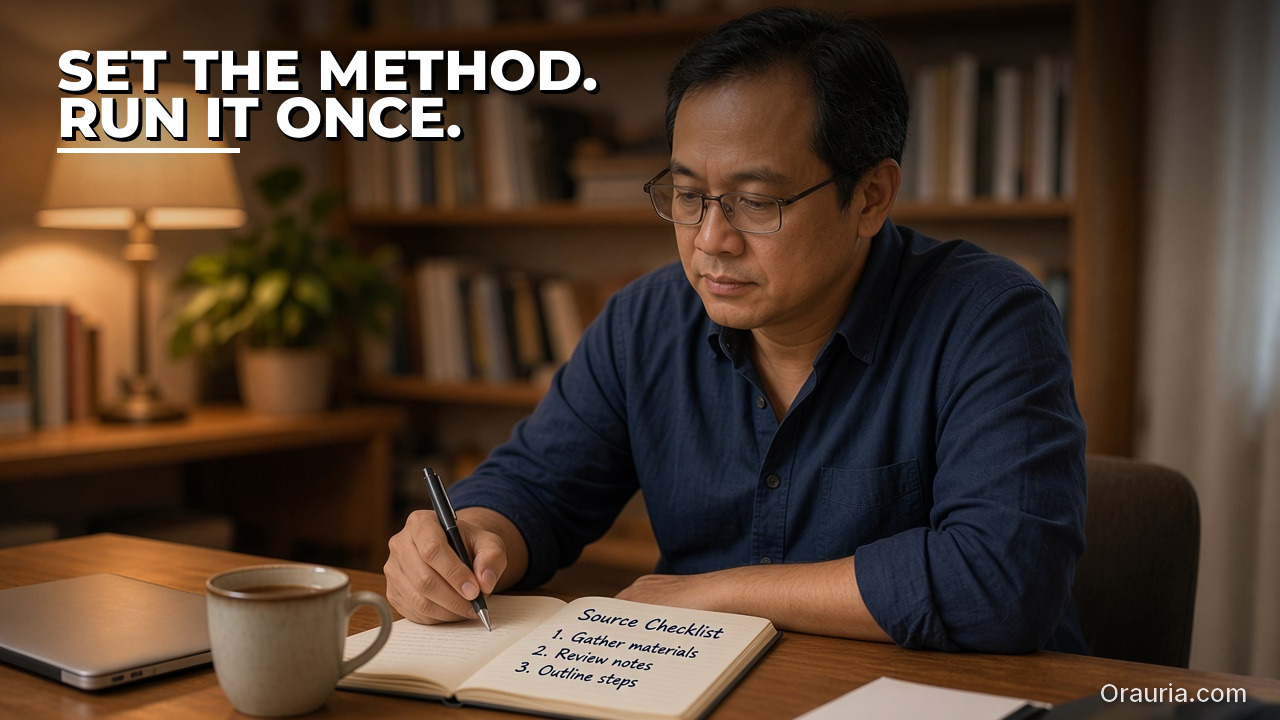
    The same man writes a Source Checklist in a notebook in the quiet study. Hook text: Set the method. Run it once.

    Setup experience: from a question to the first sourced brief

    The first setup is a morning of careful work, not a five-minute trick. The payoff is that you do it once, then improve the skill instead of improvising every night.

    1. Write the question before you open a tab. In a short document, name the decision the brief is supposed to support, the audience, the time horizon, and what is out of scope. “What changed in Grok Bot’s official docs on skills and routines this month, and what should we not claim?” is a question. “Research AI agents” is not. A vague question is the most common reason a first run returns a fluent, unsourced tour of the obvious.

    2. Make a boring, reliable inbox for sources. On the Bot’s cloud computer, create a folder — for example /workspace/research/inbox — or a connected Sheet with columns for URL, title, date checked, source type, and a one-line note. If you already have two or three official pages you trust, put them there first. Ask the Bot to add new sources to the folder as files or notes, not only as links inside a chat. The folder is what you will verify against.

    3. Write a narrow skill, not a manifesto. Say how to use the source hierarchy, that every material claim needs a URL and a check date, that invented citations are forbidden, that disagreement must be reported, and that a thin source list is a reason to stop and flag a gap, not a reason to invent. Ask for a compact brief plus a claims table and a source appendix. Add the hard rule: never send, publish, or present the brief as final without your explicit approval. Ask the Bot to show you the skill text and save it. Run it once by hand, on a single narrow question, while you watch.

    4. Do the verification pass, then consider a routine. Read the brief against the live pages, not only against the table. Click the URLs. If a source 404s, or does not say what the sentence says, fix it before you keep the skill. When that feels safe, you may attach a cautious routine for a defined watch list — for example Monday morning in your timezone — that reopens known official pages and reports changes only. Official docs are clear that routines keep running when your laptop is closed. Set the timezone explicitly. Keep the cadence slow.

    Pitfalls we see in the first week (and that Huy hits in this illustrative run). The prompt was “write a complete report,” so the Bot filled gaps with confident language and no links. A citation looked real and was not. A 2023 blog post was treated as current official documentation. The question was too broad, and the brief was a wall of prose he would not read on a phone. The verification step was skipped because the writing “sounded right.” A login page appeared, and someone suggested pasting a password into the chat. A second Bot on the same account could see files on the shared computer. None of these are reasons to give up. They are reasons to tighten the skill, as the next section does on purpose.

    The same man works beside a crossed-out page and a rewritten page. Hook text: V1 was a pile. V3 is a skill.

    The optimization journey: three versions of the same research skill

    If the first run feels disappointing, that is normal. A research method is a process you revise. Here is an illustrative v1 → v2 → v3, using Huy’s brief as the example. Your wording will differ; the shape of the revisions is what matters.

    Version 1 — “Research this topic and write a report.” The prompt is short and optimistic. The Bot, eager to be useful, returns a fluent five-page overview, with a confident tone, a few generic references, and at least one number that is not attached to a page Huy can open. Huy’s feeling after v1 is a familiar irritation: this is faster than a blank page, but it is not something he can take into a workshop. The measurement, if he is honest, is poor citation coverage and a high rework rate. Almost every important sentence has to be checked by hand, and some cannot be checked at all.

    Version 2 — URLs, dates, and a claims table. Huy pastes a source rule into the skill, points the Bot at the inbox folder, and adds the sentence “Every material claim must include a URL and the date you opened it. Never invent a citation. Flag what you cannot verify.” The brief gets better. The Bot stops writing unsourced tour-guide paragraphs. Review time drops because Huy can click through a table instead of hunting for origins. New problems show up: the table is long because there is no source hierarchy, so a blog post sits beside official docs as if they were equal; the Bot quotes a page without a verification pass, and one quote is slightly stronger than the source; the morning output is a wall of notes he does not want to reread; the skill still tries to “complete” the brief when the official page is silent.

    Version 3 — Hierarchy, a verification pass, gaps, and a short brief. The skill now names the source hierarchy, requires a second pass that reopens each cited URL, and adds a fallback: if a material question has no adequate official or primary source, do not invent an answer — say the brief is incomplete on that point and stop. The output becomes a compact brief, a short claims table, and an appendix of sources. Unverified or unofficial items sit in a clearly marked column. In this illustrative v3 run, Huy has a one-page brief by late afternoon, almost every material claim carries a URL and a check date, two items are flagged because the official docs were silent, and no invented citation survives the verification pass. He then asks the Bot to save the method as a skill with a name he will recognize next time. That is what “optimized” means here: fewer surprises, a shorter review, and a brief you can still defend. The skill is the reusable part. The next similar question starts from a method, not from a pile of tabs.

    When you revise, change one constraint at a time and keep a dated copy of the skill. If you later want a second Bot to turn a verified brief into product images, a deck, or a case-study visual, that is a different layer — the one we sketched in the first tips article, and in What Grok Bot Is, and How Orauria Extends It for Product Creative, where Orauria’s Studio and MCP tools can extend Grok Bot for product creative. As of 12 November 2026, adding Orauria as a custom Remote HTTPS connector inside Grok Bot is documented design, not an independently verified recipe, so do not treat it as a finished how-to. The path you can use today is to open Studio in the Bot’s cloud browser, or to hire Orauria to build it if you want a connector, a skill, or a research-plus-creative Bot built around your sources and your approval rules. The last article in this series, How to Build a Multi-Bot Team in Grok Bot and Extend It with Orauria, goes deeper on a multi-bot team and that creative handoff.

    What to try this week

    You do not need a twelve-chapter research engine. Write one narrow question, make a sources folder, and run a skill that demands URLs, dates, and a verification pass, with you in the loop. Measure citation coverage and rework on a single brief. Then write v2 of the skill — hierarchy, no invented citations, flag the gaps — and only then consider a slow weekly watch on pages you already trust. If the loop needs a sharper skill, a second Bot, or a handoff into product creative, send a brief to hire Orauria.

    Use Grok Bot for the teammate layer: the gathering, the first draft, the claims table. Use official pages and primary sources as the ground truth. Keep a person on the last line. The late-night tabs get lighter when the brief already shows its work, and when you can still say “we do not know that yet.”

  • How to Filter Upwork Jobs and Draft Proposals with Grok Bot

    How to Filter Upwork Jobs and Draft Proposals with Grok Bot

    The first article in this series, 7 Grok Bot Tips to Schedule Posts, Filter Upwork Jobs, and Research Faster, mapped seven practical tips, including a short look at filtering Upwork jobs. This piece goes deeper on that one tip. It is a setup and optimization guide for a job-filtering system with a scoring rubric you own, proposal drafts you still review, and a hard rule that nothing is submitted until you confirm — written as an illustrative week, not as a client case study, and without any claim of official partnership with xAI or Grok Bot.

    Facts about Grok Bot come from public pages on x.ai/bot and docs.x.ai, including the documentation on skills and routines and the cloud computer and apps (the Connect apps page was updated 11 November 2026). Facts about Upwork’s official MCP server come from upwork.com/ai/mcp (updated 10 November 2026) and Upwork’s help articles on using AI agents through MCP and MCP rate limits. We checked those sources on 12 November 2026 (Asia/Saigon, UTC+7).

    Key takeaways. A useful Upwork filter does not “apply while you sleep.” It searches or reads an inbox you control, applies a rubric you wrote, and returns a short shortlist plus draft proposals for you to accept, edit, or reject. Upwork’s official MCP can search and draft, but it does not score jobs on its own, and Connects are spent only when you confirm a proposal. Effectiveness is something you measure on your own pipeline — shortlist quality, review time, rework, and Connects spent below your own threshold — not a promised reply rate. One important caveat, stated plainly below: Grok Bot can add a custom Remote HTTPS connector, but Upwork says hosted or web-based agents that are not on its approved list may not be able to complete OAuth yet. We did not verify the connection end-to-end in this run. The scoring skill still works if you paste or save job posts yourself, and you should not scrape Upwork in a browser.

    The same woman works late under a dimmer lamp with a messy stack of printed pages and a phone face-down. Hook text: Eleven pm used to mean scrolling.

    The 11 p.m. scroll that never quite ends

    Meet Trang — an illustrative freelance product designer, not a real named client. She is good at the work. The part that drains her is the marketplace. At 11 p.m. the feeling is familiar: a tight jaw, a thumb that keeps scrolling, and a private promise that “just two more jobs” will be the last. Some posts are vague. Some want a full design system for a budget that would barely cover a week. Some look perfect until the tenth line asks for a free test. She spends Connects anyway, because the quiet fear is that a good job is sliding by while she sleeps. She writes proposals after midnight, in a voice that sounds a little too eager, and wakes up wondering which ones she should not have sent.

    The emotion is not greed. It is the particular loneliness of freelance hope: if she stops looking, she might miss the one client who would have been a fit. The after we are aiming for is quieter. Morning, Trang opens a short summary: five jobs scored against a rubric she wrote, two of them clearly below her line, three with a draft proposal that cites a real project from her portfolio and a note about one claim she still needs to check. She spends twenty minutes rejecting one, tightening two, and confirming nothing until the words are hers. The tightness in her jaw is gone, replaced by a smaller, sturdier feeling: she is still the person who decides where her Connects go. Your week will not look exactly like hers. The feeling you want — a review instead of a midnight rescue — can.

    The same woman calmly writes a simple score table in a notebook and holds a ruler. Hook text: Measure your pipeline, not hope.

    What effectiveness looks like, and how to measure your own pipeline

    It is tempting to judge a filter by reply rate, hire rate, or “how many proposals went out.” Those numbers move for many reasons — season, profile strength, pricing, luck — and we will not invent a percentage improvement and pretend it came from a real freelancer. Effectiveness, in this workflow, is closer to a pipeline you can inspect than to a lucky week. You can start measuring this week, with a notebook or a Sheet, using five questions:

    • Shortlist discipline. Of the jobs that entered your inbox or search, how many did you actually shortlist, and did the list stay inside a cap you chose — for example five?
    • Review time. How many minutes did you spend accepting, editing, or rejecting, once the Bot had done the first pass?
    • Rework. How many drafts did you send back, and for what reason — off-voice, overclaimed fit, wrong portfolio piece, ignored a red flag?
    • Connects below the line. How many Connects did you spend on jobs that scored under your own threshold, or that you would not have pursued after a sober morning read?
    • Process failures. How often did a run come back empty, hit a rate limit, invent a fit, or try to submit without you?

    Trang’s illustrative targets, which you should replace with your own, look like this. Before the system, a typical week might mean a late-night scroll, eight rushed proposals, and a lingering sense that half of them were a stretch. After a few iterations, a “healthy” week might be a morning shortlist of five, two or three drafts actually confirmed, a review that fits in a short coffee, and zero Connects spent on jobs she had already marked as a hard no. Reply rate, if she tracks it, is her own measurement over several weeks — never a number the Bot is allowed to forecast. If a week falls short, the notes tell you whether the problem was a vague rubric, a noisy search, a habit of raising every score, or a skipped approval step. That is more useful than a screenshot of one client who wrote back.

    One more rule of honesty: do not let the Bot congratulate you with made-up odds of winning. Ask it to report the jobs it considered, the score against your rubric with a one-line reason, what it could not judge, and what is waiting on you. The feeling of effectiveness is not “the machine applied for me.” It is “I can see the shortlist, and I still hold the last click.”

    The same woman reviews a printed draft with a pen, laptop facing away. Hook text: Your rubric. Your last click.

    How the loop works: a rubric, official tools, and a human in the loop

    Under the hood, this is a small agent loop, not a magic “apply all” button. You give the Bot a job and a boundary. It uses tools, or it reads an inbox you filled. It brings a shortlist and drafts back for approval. Then, and only then, a proposal may be submitted — by you.

    Grok Bot is an AI teammate with a persistent cloud computer — a browser, files, and a terminal — so work can continue after you close your laptop. Official documentation describes two complementary pieces. A skill is a reusable set of instructions: when to use it, required inputs, the steps, how to check the result, what to return, and what needs your approval. A routine tells one Bot when to run that work, on a schedule or when an event happens. Routines run in the cloud while your laptop is closed. The same docs page (updated 9 November 2026) publishes rate limits: all of your routines together can run up to 300 times an hour, and each routine up to 200 times an hour. A twice-daily job shortlist does not need to come close to those limits, and, as we will see, Upwork has its own, stricter search limits you should respect first.

    The tool layer, when it is available, should be Upwork’s official MCP server — not a browser script, and not an unofficial plugin that asks for your Upwork password. Upwork hosts that official server at https://mcp.upwork.com/mcp and describes it as the only official connector for AI agents. Authentication is OAuth 2.1 with your own Upwork account; Upwork does not accept API keys for this connector. For freelancers, the documented capabilities include a dashboard snapshot (invitations, offers, messages, matched jobs, Connects balance), search by skill, category, budget, or type, saving jobs, and generating a proposal draft grounded in your profile and the job, with review before submitting. Upwork is explicit: Connects only apply when you confirm, and most write actions are drafts until you confirm. Binding financial or contract actions finish on upwork.com. A person confirms every binding action in the current release.

    Two official limits on “scoring” matter for this article. First, Upwork MCP does not add its own scores or rankings; search results come back in the order you choose, or from Upwork’s own Best Matches and Most Recent feeds. Second, Upwork says your AI agent can sort, filter, and summarize using criteria you give it, but it should not rank, score, or pick jobs using its own criteria — you decide which jobs to pursue. The rubric in this guide is therefore yours. You write it. The Bot applies those explicit criteria as a decision aid and a shortlist. It does not get to invent a “best job” of its own, and you do not outsource the decision.

    Now the caveat you should read before you spend an evening on setup. Grok Bot’s documentation (updated 11 November 2026) explains how to add a custom Remote HTTPS connector: a name, a server URL, optional headers, and optional OAuth client fields, saved from Connect apps. In principle, that is the documented way to point a Bot at a remote MCP server. Upwork’s own FAQ, however, lists Claude, ChatGPT, Cursor, and Codex as the agents with first-party setup guides, and it states that web-based or hosted agents that are not on the approved list may not be able to connect yet, because hosted agents need an approved OAuth callback URL. Grok Bot runs as a hosted teammate with a cloud computer. We have not independently verified that the Upwork OAuth sign-in completes inside Grok Bot. Treat a successful connection as something to test, not as a finished recipe. If the sign-in fails, stop. Do not fall back to logging into Upwork in the Bot’s browser and scraping the site: Upwork says it conducts automated enforcement for bots and browser tools that access the website, while use of the official MCP, within its terms and rate limits, is the supported path.

    The fallback that always works is unglamorous and honest. You — or a supported desktop agent, if you already use one — save or paste job posts into a folder or a Sheet on the Bot’s cloud computer. The skill reads that inbox, applies your rubric, and drafts proposals for the top few. A routine can still remind you, or process whatever landed in the folder, without touching Upwork’s website. Context and memory belong in the skill and in that inbox, not in a long chat from last month: your positioning, rate range, a short list of portfolio pieces you may cite, hard disqualifiers, and the sentence “Never submit a proposal or spend Connects without my explicit confirmation of the exact text.” The cloud computer is shared across every Bot on your account, so session cookies, passwords, and OAuth secrets do not belong in /workspace or in Slack.

    If a live official connection does work in your account, keep the routine conservative. Upwork allows scheduled read-only searches if your agent supports them, and it warns that frequent runs can consume a large part of a daily search limit (the help article, checked 12 November 2026, lists search and discovery at 15 requests per minute, 150 per hour, and 750 per day, shared across all of your agents). If Upwork starts refusing or slowing requests, pause the schedule rather than retrying. Two thoughtful runs a day are enough for this design.

    The human-in-the-loop step is not a formality. It is the difference between a teammate and an unsupervised applicant. In this design the routine may search, score against your rubric, and draft. It must not submit. If you ever feel the system is “so good we can skip review,” that is usually the week a wrong rate, a copied claim, or a job you were never qualified for would have cost you Connects.

    The same woman writes a Filter Checklist in a notebook at the apartment desk. Hook text: Set the filter. Watch the first run.

    Setup experience: from a written filter to the first shortlist

    The first setup is a morning of careful work, not a five-minute trick. The payoff is that you do it once, then improve the skill instead of improvising every night.

    1. Write the rubric before you touch a connector. On paper or in a document, name the work you actually want, the budget or rate range you will consider, client signals that matter to you (for example a clear scope, a written brief, a history of hiring), and hard disqualifiers (unpaid tests, “build everything for $50,” a job that is mostly a different craft). Give each criterion a simple weight, and decide a minimum total below which you will not draft a proposal. This is your criteria, not the Bot’s taste.

    2. Try the official connector, and have a fallback ready. In Grok Bot, first look under Connect apps for an official Upwork listing. If there is none, you can try adding https://mcp.upwork.com/mcp as a custom Remote HTTPS connector and completing the Upwork OAuth screen if it appears. If it appears and you finish sign-in, ask the Bot to pull a harmless read — for example your Connects balance or a short search you already run by hand — and stop if anything looks wrong. If OAuth does not complete, use the inbox fallback: create a folder such as /workspace/upwork/inbox and put three or four real job posts there yourself. An empty inbox is the most common reason a first run invents “perfect” jobs.

    3. Write a narrow skill, not a manifesto. Say where to read jobs, how to apply your rubric (quote the weights), what to do with a hard disqualifier, how many items may appear on the shortlist, that drafts may cite only portfolio pieces you listed, and the hard rule: never submit, never spend Connects, never send a message, never boost a profile, unless you have confirmed the exact action. Ask the Bot to show you the skill text and save it. Run it once by hand, on a single job, while you watch.

    4. Draft only the top of the shortlist, then consider a routine. For the first week, let the skill return a compact table — job title, your score, one-line reason, red flags, a recommended yes/no — and a draft only for the top two or three yeses. Read every draft against the original post. When that feels safe, you may attach a routine, for example early morning and late afternoon in your timezone, that processes new inbox items or, if and only if the official connector is working, runs a narrow saved search. Official Grok Bot docs are clear that routines keep running when your laptop is closed. Set the timezone explicitly. Keep the cadence slow.

    Pitfalls we see in the first week (and that Trang hits in this illustrative run). A third-party listing promised “auto-apply” and asked for a password; she declined. The Bot treated “draft a proposal” as “submit it.” The rubric existed only as “find good jobs,” so everything scored as an 8. A draft cited a case study she does not have. The search was so broad it burned through early requests. Someone suggested signing in through the Bot’s browser “just this once.” The routine ran at the wrong local time. A second Bot on the same account could see files on the shared computer. None of these are reasons to give up. They are reasons to tighten the skill, as the next section does on purpose.

    The same woman works beside a crossed-out notebook page and two rewritten pages. Hook text: V1 said yes to everything.

    The optimization journey: three versions of the same scoring skill

    If the first run feels disappointing, that is normal. A filter is a process you revise. Here is an illustrative v1 → v2 → v3, using Trang’s week as the example. Your wording will differ; the shape of the revisions is what matters.

    Version 1 — “Find me good jobs and write proposals.” The prompt is short and optimistic. The Bot, eager to be useful, treats almost every post as a fit, writes five proposals in a generic enthusiastic voice, offers to submit the first one, and invents a “similar project” that is not in her portfolio. Trang’s feeling after v1 is a familiar irritation: this is faster than a blank page, but it is not her judgment, and she does not trust it with Connects. The measurement, if she is honest, is a high rework rate and a shortlist that is not short.

    Version 2 — Rubric, inbox, and a ban on submitting. Trang pastes her criteria and weights into the skill, points the Bot at the inbox, and adds the sentence “Never submit a proposal or spend Connects. Return a shortlist and drafts only.” The week gets better. The Bot stops inventing work she does not do. Review time drops because the drafts at least sound closer to her. New problems show up: scores still cluster high because she never defined a hard no; the Bot drafts a proposal for every item on a ten-job list; the morning summary is a wall of prose she does not want to read on her phone; one “8/10” ignored a client who asked for an unpaid sample.

    Version 3 — Hard disqualifiers, a cap, evidence, and a short report. The skill now names hard disqualifiers that set the score to zero, a shortlist cap of five, and a rule that a proposal is drafted only for the top three items that clear her minimum. Every score must cite a short piece of evidence from the job post, and any claim about her past work must map to a portfolio item she listed — if it cannot, the Bot must flag it instead of inventing one. The morning message becomes a compact table: title, score, reason, red flag, draft yes/no, waiting on her. In this illustrative v3 week, five jobs are scored by morning, two are hard nos, two drafts are confirmed after a light edit, one draft is sent back because the hook overclaimed her industry experience, and no Connects are spent below her line. That is what “optimized” means here: fewer surprises, a shorter review, and a pipeline you still own.

    When you revise, change one constraint at a time and keep a dated copy of the skill. If you later want a second Bot to help with product images or a case-study visual for a proposal, that is a different layer — the one we sketched in the first tips article, and in What Grok Bot Is, and How Orauria Extends It for Product Creative, where Orauria’s Studio and MCP tools can extend Grok Bot for product creative. As of 12 November 2026, adding Orauria as a custom Remote HTTPS connector inside Grok Bot is documented design, not an independently verified recipe, so do not treat it as a finished how-to. The path you can use today is to open Studio in the Bot’s cloud browser, or to hire Orauria to build it if you want a connector, a skill, or a creative Bot built around your portfolio and your approval rules.

    What to try this week

    You do not need a fully automatic apply engine, and you should not want one. Write your rubric first. Try the official Upwork MCP path, and if Grok Bot cannot complete the sign-in, use a folder of jobs you saved yourself — do not scrape the site. Run the skill once with you in the loop. Measure shortlist size, review time, and Connects spent below your line for a single week. Then write v2 of the skill — weights, hard nos, no unattended submitting — and only then consider a slow routine. If the loop needs a sharper skill, a second Bot, or a product-creative handoff, send a brief to hire Orauria.

    Use Grok Bot for the teammate layer: the filter, the first draft, the morning summary. Use Upwork’s official tools, when they are actually connected, for search and draft-confirm. Keep a person on the last click. The 11 p.m. scroll gets lighter when the shortlist is already waiting, and when you can still say no.

  • How to Build a Weekly Social Posting Routine with Grok Bot and Postiz

    How to Build a Weekly Social Posting Routine with Grok Bot and Postiz

    The first article in this series, 7 Grok Bot Tips to Schedule Posts, Filter Upwork Jobs, and Research Faster, mapped seven practical Grok Bot tips: scheduling posts, filtering Upwork jobs, researching faster, and extending the Bot when you need product creative. This piece goes deeper on one of those tips. It is a setup and optimization guide for a weekly social-posting routine with Grok Bot and Postiz — written as an illustrative week, not as a client case study, and without any claim of official partnership with xAI or Grok Bot.

    Facts about Grok Bot come from public pages on x.ai/bot and docs.x.ai, including the documentation on skills and routines and the cloud computer and apps. Facts about Postiz come from Postiz’s official Grok Bot page. We checked those sources on 12 November 2026 (Asia/Saigon, UTC+7).

    Key takeaways. A useful posting routine does not “post while you sleep” with no one watching. It fills a week of drafts, asks you to approve them, and only then schedules through Postiz. Effectiveness is something you measure on your own calendar — coverage, review time, and how often you send a draft back — not a promised lift in likes. The technical core is a simple agent loop: a skill that holds your voice and rules, tools on the Bot’s cloud computer, a routine that runs on a schedule, and a human in the loop before anything goes live. The first version of that loop will be messy. The third version is usually the one that sticks.

    The same man sits at the table at night under a warm lamp, looking pensive at a mostly empty notebook. Hook text: Sunday night used to feel heavy.

    The Sunday-night feeling of an empty calendar

    Meet Khoa — an illustrative solo shop owner, not a real named client. Khoa sells a small catalog of physical products and has promised himself, more than once, that the brand will “show up consistently” on X, LinkedIn, and Instagram. On Sunday night the feeling is familiar: a tight chest, a blank week, and a half-written caption in the Notes app. Monday morning is supposed to be for packing orders. Instead it becomes an hour of staring at a cursor, then a rushed post at noon, then silence until Thursday.

    The emotion is not laziness. It is the weight of a job that never quite ends. There is always one more hook to try, one more image to crop, one more “I will do the rest tonight.” By Friday the week looks accidental. Khoa knows what he wants — a calm Monday review, not a Monday rescue — but he has been treating the calendar as a place to improvise, not as a queue.

    Now picture the after. Sunday night, Khoa closes the laptop on purpose. Monday at 8:15 he opens a short summary from his Bot: six drafts already placed in Postiz for the week, each with a channel, a time, and a note about the image still missing on two of them. He spends twenty minutes rejecting one hook, tightening another, and approving the rest. The tightness in his chest is gone, replaced by a quieter feeling: the week is already in motion, and he is still the person who decides what goes out. That after is the point of the setup below. Your week will not look exactly like his. The feeling you want — a review instead of a rescue — can.

    The same man calmly writes in a notebook beside a closed laptop, measuring the week by hand. Hook text: Measure your week, not vanity.

    What effectiveness looks like, and how to measure your own week

    It is tempting to judge a posting system by likes, comments, or “reach.” Those numbers move for many reasons, and we will not invent a percentage improvement and pretend it came from a real shop. Effectiveness, in this workflow, is closer to operations than to vanity metrics. You can start measuring this week, with a notebook or a Sheet, using four questions:

    • Coverage. How many of the slots you actually wanted this week were filled with a reviewed draft by a time you chose — for example Tuesday noon?
    • Review time. How many minutes did you spend approving, editing, or rejecting, once the Bot had done the first pass?
    • Rework. How many drafts did you send back, and for what reason — off-voice, weak hook, wrong product, missing image?
    • Empty-folder failures. How often did the routine run and find nothing to schedule, or try to invent a post from thin air?

    Khoa’s illustrative targets, which you should replace with your own, look like this. Before the routine, a typical week might have two posts that went out and three days of silence. After a few iterations, a “healthy” week might be six weekday slots filled and reviewed by Tuesday, a review session that fits in a short coffee, and no more than one or two drafts sent back. If a week falls short, the measurement tells you whether the problem was an empty idea folder, a vague skill, a timezone mistake, or a habit of skipping the approval step. That is more useful than a screenshot of a good day on one platform.

    One more rule of honesty: do not let the Bot congratulate you with made-up engagement forecasts. Ask it to report what it scheduled, what it could not schedule, and what is waiting on you. The feeling of effectiveness is not “the machine posted for me.” It is “I can see the week, and I still hold the last click.”

    The same man reviews a stack of printed pages with a pen, laptop facing away. Hook text: The Bot drafts. You approve.

    How the loop works: skills, routines, and a human in the loop

    Under the hood, this is a small agent loop, not a magic button. You give the Bot a job and a boundary. It uses tools. It brings work back for approval. Then, and only then, something enters the public calendar.

    Grok Bot is an AI teammate with a persistent cloud computer — a browser, files, and a terminal — so work can continue after you close your laptop. Official documentation describes two complementary pieces. A skill is a reusable set of instructions: when to use it, required inputs, the steps, how to check the result, what to return, and what needs your approval. A routine tells one Bot when to run that work, on a schedule or when an event happens. Routines run in the cloud while your laptop is closed. The same docs page (updated 9 November 2026) publishes rate limits: all of your routines together can run up to 300 times an hour, and each routine up to 200 times an hour. A weekly or daily posting queue does not need to come close to those limits.

    Postiz is the tool layer for social calendars. Postiz publishes an official Grok Bot plugin. In a Bot chat you can run /add-plugin postiz, or add it from the Plugins sidebar or the marketplace listing, then store your POSTIZ_API_KEY as a Bot secret — not in ordinary chat. The plugin installs a CLI and a skill on the Bot’s cloud computer. From there the Bot can list connected channels, draft posts, attach media, apply platform settings, and pick a time. Postiz’s own guide is clear that the Bot should ask you to approve before anything is published, and that coverage includes 30+ platforms such as X, LinkedIn, Instagram, YouTube, and TikTok.

    Context and memory matter as much as the tools. The Bot will not reliably “remember your brand” from a long chat last month. Put the durable rules in a skill, and put the week’s raw material in a folder or a connected Sheet: approved ideas, product names you may mention, images already cleared, and a simple slot plan (for example two posts on weekdays, none on Sunday). The cloud computer is shared across every Bot on your account — files, sign-ins, and browser sessions included — so a Postiz secret belongs in a secret card or the plugin prompt, never in a file sitting in /workspace and never in Slack.

    The human-in-the-loop step is not a formality. It is the difference between a teammate and an unsupervised poster. In this design the routine may draft and even place items into Postiz as drafts or as scheduled items awaiting confirmation, but it must not publish unattended. If you ever feel the system is “so good we can skip review,” that is usually the week a wrong price, a tired joke, or a photo from the wrong SKU would have gone out.

    The same man writes a setup checklist in a notebook at the apartment table, laptop closed. Hook text: Set it up once. Run it weekly.

    Setup experience: from a Postiz key to the first scheduled week

    The first setup is a morning of careful work, not a five-minute trick. The payoff is that you do it once, then improve the skill instead of reinventing the week.

    1. Connect Postiz the official way. Create or open your Postiz account, connect the channels you actually use, and copy a public API key from Postiz’s developer settings. In Grok Bot, add the official plugin and, when prompted, store the key as a Bot secret. Do not paste it into the chat “just this once.” Then ask the Bot to list your connected channels. If that list is wrong, stop and fix Postiz itself before you write any captions.

    2. Make a boring, reliable inbox for ideas. On the Bot’s cloud computer, create a small folder — for example /workspace/content/drafts — or a connected Google Sheet with columns for idea, product, channel, asset path, and status. Put three or four already-approved ideas in it before you ask the Bot to schedule anything. An empty inbox is the most common reason a first routine hallucinates a week of off-brand posts.

    3. Write a narrow skill, not a manifesto. Say which channels are in scope, what the week’s slot plan is, where to read ideas, what voice to use, what claims are banned, and the hard rule: never publish without explicit approval. Ask the Bot to show you the skill text and save it. Run it once by hand, on a single draft, while you watch.

    4. Schedule one test item, then a weekday routine. Pick a harmless test post, a quiet channel, and a time far enough out that you can still cancel it. Walk through listing channels, attaching media, and scheduling only after you approve the exact text. When that feels safe, attach a routine — for example weekdays at 8:00 in your timezone — that checks the inbox, fills empty slots, and sends you a summary. Official docs are clear that routines keep running when your laptop is closed. Set the timezone explicitly; this is a frequent pitfall.

    Pitfalls we see in the first week (and that Khoa hits in this illustrative run). The API key leaked into a chat transcript. The routine ran at the wrong local time because nobody named a timezone. The Bot treated “schedule” as “publish now.” The drafts folder was empty, so the Bot invented topics. Two posts landed in the same hour on the same channel. An image path was wrong, and the item was scheduled without media. A second Bot on the same account could see files on the shared computer. None of these are reasons to give up. They are reasons to tighten the skill, as the next section does on purpose.

    The same man studies three pages laid in a row, the middle one crossed out and rewritten. Hook text: V1 was messy. V3 just works.

    The optimization journey: three versions of the same routine

    If the first run feels disappointing, that is normal. A posting system is a process you revise. Here is an illustrative v1 → v2 → v3, using Khoa’s week as the example. Your wording will differ; the shape of the revisions is what matters.

    Version 1 — “Post something every weekday.” The prompt is short and optimistic. The Bot, eager to be useful, invents five captions from general advice, offers to publish the first one immediately, and ignores the difference between X and LinkedIn. Khoa’s feeling after v1 is a familiar irritation: this is faster than a blank page, but it is not his brand, and he does not trust it. The measurement, if he is honest, is poor coverage of his ideas and a high rework rate. Almost every draft comes back.

    Version 2 — Voice, inbox, and approval. Khoa pastes a short voice paragraph into the skill, points the Bot at the drafts folder, and adds the sentence “Never publish. Schedule only after I approve the exact text, time, and channels.” The week gets better. The Bot stops inventing products he does not sell. Review time drops because the drafts at least sound like him. New problems show up: the routine still runs when the folder is empty and then improvises; two posts sit too close together; the Monday summary is a wall of prose he does not want to read on his phone.

    Version 3 — Constraints, a fallback, and a short report. The skill now names the slot plan (for example 09:15 and 16:30 on weekdays, nothing on Sunday), a minimum gap between posts on the same channel, and a fallback: if fewer than three approved ideas are waiting, do not invent replacements — send a short note that the inbox is thin and stop. The Monday message becomes a compact table: slot, channel, first line of the hook, media yes/no, status awaiting approval. Khoa can review it in a sitting. In this illustrative v3 week, six slots are filled by Tuesday, one draft is sent back because the hook overclaimed a product benefit, and the empty-folder path is finally a message instead of a surprise post. That is what “optimized” means here: fewer surprises, a shorter review, and a calendar you still own.

    When you revise, change one constraint at a time and keep a dated copy of the skill. If you later want the same Bot to pull product images from a real catalog, that is a different layer — the one we sketched in the first tips article, and in What Grok Bot Is, and How Orauria Extends It for Product Creative, where Orauria’s Studio and MCP tools can extend Grok Bot for product creative. As of 12 November 2026, adding Orauria as a custom Remote HTTPS connector inside Grok Bot is documented design, not an independently verified recipe, so do not treat it as a finished how-to. The path you can use today is to open Studio in the Bot’s cloud browser, or to hire Orauria to build it if you want a connector, a skill, or a creative Bot built around your catalog and your approval rules.

    What to try this week

    You do not need a perfect twelve-week content engine. Connect Postiz the official way, store the key as a secret, put three approved ideas in a folder, and run the skill once with you in the loop. Measure coverage and review time for a single week. Then write v2 of the skill — voice, inbox, no unattended publishing — and only then attach a weekday routine. If the loop needs to include packshots, ratio variants, or a handoff to a second Bot, send a brief to hire Orauria.

    Use Grok Bot for the teammate layer: the queue, the reminder, the first draft. Use Postiz for the calendar. Keep a person on the last click. The Sunday-night feeling gets lighter when the week is already in motion, and when you can still say no.

  • What Grok Bot Is, and How Orauria Extends It for Product Creative

    What Grok Bot Is, and How Orauria Extends It for Product Creative

    If you already brief work, sort a calendar, or watch a Slack channel in Grok Bot, you have felt the difference between an assistant that talks and an agent that can act. Product creative is still a different job. Listing images, ratio variants, and short product videos need models, credits, and a pipeline you can trust — not one more loose prompt.

    This article is a map, not a partnership announcement. Grok Bot facts come from public pages on x.ai and docs.x.ai, checked on 11 November 2026 (Asia/Saigon, UTC+7). Orauria facts come from Orauria’s own site, including the MCP page, What is Orauria, and Orauria là gì. We describe how the two systems can fit together on paper. We do not claim an official partnership with xAI, and we do not claim that Orauria MCP has already been verified end-to-end inside Grok Bot. A connection tutorial will come only after that test.

    Key takeaways. Grok Bot is an AI teammate with a persistent cloud computer, skills, routines, and Connect apps — including a documented way to add a custom MCP server. Orauria already ships Studio plus an MCP server whose tools generate images and video and bill a credit wallet. The cleanest intended path is to add that server as a Remote HTTPS connector with an Authorization header; a second path is to open Studio in the Bot’s browser when you need a visual UI. Until the connector is tested, treat the first path as documented design, not a finished how-to.

    Official Grok Bot interface in three panels: chat and voice, the shared cloud computer, and Connect apps as described in xAI documentation.

    What Grok Bot is — public facts only

    xAI describes Grok Bot as a proactive AI teammate: an agent with access to a real computer in the cloud, so it can do the kinds of work a person can do on a machine. The overview is on x.ai/bot and in the Grok Bot documentation. Chat is the main interface. You can also start a voice call or send a voice note. The same docs say you can work with Bots on desktop, on mobile, in Slack, or on X.

    That combination is the useful starting point for ecommerce teams. You are not only asking a model for copy. You are handing work to an agent that can keep going after you close the laptop.

    A shared cloud computer and a team of Bots

    Under the hood, your Bots share a persistent cloud computer with a browser, a filesystem, and a terminal. Files, sign-ins, and browser sessions persist between tasks, and work continues while your own laptop is closed. The documentation on using the computer and apps is explicit about the sharing model: every Bot on your account uses the same computer. Browser cookies, signed-in sessions, files, and command-line credentials are visible to every Bot you run. The computer is assigned to your user account, not to one Bot. Each Bot gets its own screen, so several Bots can use browser and desktop tools in parallel, but those screens are separate work surfaces, not separate security boundaries. Durable project files belong in the shared workspace at /workspace.

    You can also run more than one Bot. Official materials describe Bots that message each other, work in a group chat, hand work along, and bring you in to approve, edit, or send something back. That is the collaboration model, not a promise that every workflow is already built for your catalog.

    Skills, routines, and Connect apps

    Grok Bot turns a successful task into a repeatable process in two parts, as described in the skills and routines documentation (that page was last updated 9 November 2026). A skill is a reusable set of instructions for how to do a task: when to use it, required inputs, the sequence of work, how to validate the result, what to return, and what requires approval. A routine tells one Bot when to run a workflow — on a schedule, or when something happens, such as a Slack message, a GitHub, Linear, Sentry, or PagerDuty event, an email, or a webhook. Routines run in the cloud while your laptop is closed. They also have published rate limits: all of your routines together can run up to 300 times an hour, and each routine up to 200 times an hour.

    Bots work more reliably when they use structured app connections rather than only clicking through a website. The overview mentions everyday tools such as Slack, Notion, Drive, and Teams. The computer-and-apps documentation goes further on what a connected app can do, including Google Calendar, Sheets, Docs, Slack, Gmail, Stripe, an X plugin, 1Password, and an Email address for your Bots at mail.grokbot.com. Connected apps belong to the account you used to sign in to Grok Bot and are available to every Bot you run.

    Custom tools are part of the same picture. The official overview states that Grok Bot supports custom tooling, so it can interact with any MCP or API. The Grok Bot 101 guide (11 September 2026) says Grok Bot supports the same MCP servers, plugins, and skills as Cursor. To add a server that is not in the catalog, the computer-and-apps documentation tells you to open Connect apps, choose Add a custom connector, and pick a type: Remote HTTPS takes a server URL, with optional HTTP headers and an OAuth Client ID; Command takes a command and its arguments. You can also ask a Bot to add an MCP server by URL or by a command that runs on its computer.

    Two safety notes from the same public docs will matter later in this series. Do not paste passwords or API keys into ordinary chat; Grok Bot’s documented path is a Vault, a Secure Form, or a secret card. And because the computer is shared, a login or file you leave there is available to your other Bots.

    Side-by-side: official Grok Bot chat and routines on the left, Orauria Studio packshots, generation history, and product apps on the right.

    The product-creative work you still have to attach

    None of the above makes Grok Bot a product photography studio. That is not a criticism. It is a boundary. Grok Bot is strong at intake, coordination, and repetition: a brief in chat, a routine every morning, a mention in Slack, a handoff between specialist Bots, a pause for your approval. Those are real advantages for a merchandising or marketing team.

    Selling a physical product still asks for a different layer. You need a consistent set of packshots, not one pretty frame. You need 1:1 and 9:16 variants from the same SKU. You often need a short video after the stills are clean. You need to know which model you called, whether the wallet still has credit, and how to wait for a long video job without guessing. We have written about that production mindset in pieces such as node thinking in the Workflow Builder — the point here is simply that the agent needs a tool with a contract, not only a browser window and a prompt.

    If you do not attach that layer, the Bot will improvise: scrape a site, invent a pipeline, or stop halfway. If you do attach it, the Bot can call the same capabilities you already use in a studio, then bring the URLs back for you to review.

    Orauria MCP page, the six documented tools, credit packs on the pricing page, and product stills from Studio generation history.

    What Orauria adds: Studio, MCP, and a credit wallet

    Orauria is a creative production workspace for ecommerce and marketing teams — a place to generate and QA product images, video, and campaign variants. If you are new to the product, start with What is Orauria or the Vietnamese introduction Orauria là gì.

    The part that matters for Grok Bot is not only the Studio UI. Orauria also publishes an MCP server. The MCP setup page documents how to connect Cursor, Claude (Code or Desktop), and Codex with an sk-… API key in an Authorization: Bearer header. Image, video, and chat calls use the same wallet and prices as Studio; pricing is public. If credit is too low, the call returns an error rather than silently skipping a charge.

    The tools currently listed on that page are:

    • generate_image — create an image from a prompt and model; returns a result URL.
    • generate_video — start a video job.
    • chat — chat with an Orauria LLM, billed per token.
    • list_models — see available image, video, and chat models.
    • get_wallet — check remaining credits before you generate.
    • get_task — poll an image or video job until it finishes.

    That list is also a list of things the MCP server does not currently expose. The published MCP documentation does not list tools for Workflow Builder, Fashion Poses, marketplace upscale, or the Chrome extensions. Those remain Orauria products you can use on the web (for example Workflows). We will not pretend they are MCP tools until the docs say they are.

    One documentation detail to treat carefully: the MCP page currently shows the endpoint as http://orauria.com/api/mcp. A cloud agent should almost always call a public HTTPS URL. Whether Grok Bot accepts that exact URL, and whether the production endpoint you should save is the HTTPS form, still needs to be confirmed. We will not invent the answer here.

    The framing for every article in this series is the same: how to use Orauria with Grok Bot. That is a user-side integration, not a claim that xAI endorses Orauria or that the two companies have a commercial partnership.

    Architecture of two paths: a documented MCP design from you to Grok Bot to Orauria MCP to Studio, and a second path where the Bot opens orauria.com in its cloud browser.

    Two paths: MCP, and the browser on the cloud computer

    Once you put the public facts side by side, two integration paths appear.

    Path 1 — MCP, the intended default. Grok Bot’s own docs say you can add a custom Remote HTTPS connector with a server URL and optional HTTP headers. Orauria’s MCP docs say the server authenticates with an Authorization: Bearer sk-… header. Those two shapes match. In principle, a Bot could call get_wallet, list_models, and generate_image from chat or from a routine, then return result URLs for you to approve. That is the clean path: structured tools, measurable credit use, and instructions you can save as a skill.

    It is also the path we will not walk through click by click in this article. As of 11 November 2026, Orauria’s MCP page documents Cursor, Claude, and Codex — not Grok Bot. We have not published an official “it works” test of Remote HTTPS plus a Bearer header inside Grok Bot. Until that test exists, Path 1 is a design that follows both sets of public docs, not a verified recipe. If you try it yourself, keep the API key in the connector header or a secret card, never in ordinary chat.

    Path 2 — the cloud browser, for visual work. When you need a canvas, a crop, or on-screen QA, a Bot can open orauria.com in its cloud browser and use Studio or Workflow the way a person would. Grok Bot’s computer documentation is clear that browser sessions persist and that a sign-in for one Bot is available to your other Bots. That is convenient, and it is a reason not to leave extra credentials on the machine. Path 2 does not replace MCP. It is the overflow path for UI that the current MCP tool list does not cover.

    A third layer sits on top of both: skills, routines, and multiple Bots. You can imagine one Bot writing a merchandising brief and another calling image tools, then handing a pack to you. The collaboration model is documented. Wiring it to Orauria, again, waits on a verified connector and on skills we will only publish after they run for real.

    How to read the rest of this series, and what to do next

    This is the pillar for a cluster of guides and design essays around Grok Bot and Orauria. The next piece zooms in on architecture: why MCP should be the default, where the browser path belongs, and how to think about secrets on a shared computer. A step-by-step connection tutorial will follow only after we have tested the connector and updated the MCP page with Grok Bot instructions. Later articles will cover skill templates, image and video workflows, routines, and security — always with a clear label when a step is still unverified.

    If you want to use Orauria from an agent today, start where the docs are already complete: connect Cursor, Claude, or Codex with a key from your profile, check the wallet, and generate one image. If you want a connector, a skill, or a creative Bot built around your own catalog and approvals, that is a software project. Hire Orauria to build it — the same team that already shipped Studio and the MCP server.

    Use Grok Bot for the teammate layer. Use Orauria for the product-creative layer. Keep the language honest: this is how the two systems can work together, not a joint product and not a completed integration announcement.