Danh mục: Creative Thinking & Frameworks

Mental models, art direction, and creative strategy with AI — frameworks for lookbooks, brand consistency, and new ways to think about visual production.

  • Image-to-Video: So sánh model theo nút thắt (Minimax vs Veo vs khác)

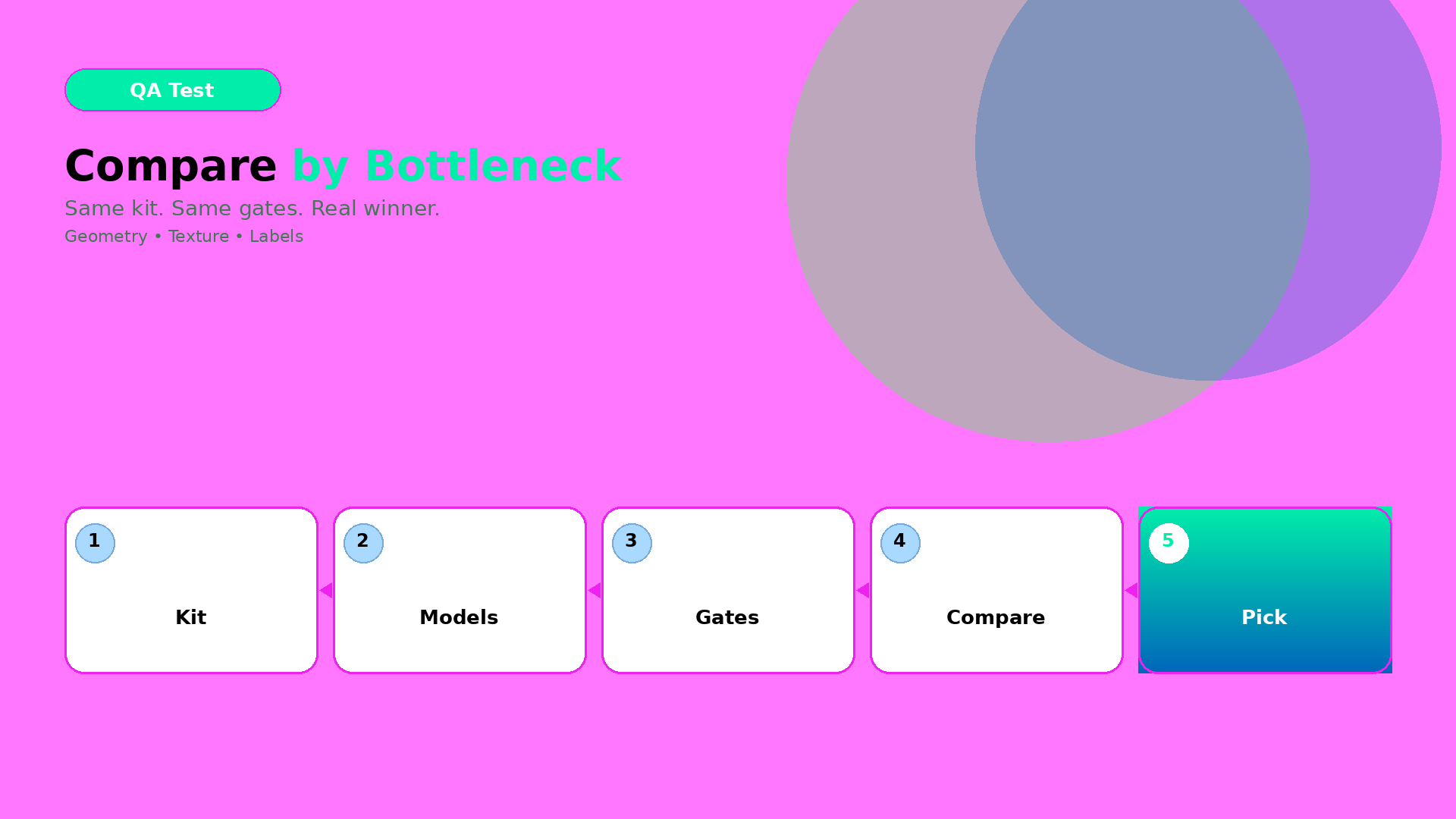
    Image-to-Video: So sánh model theo nút thắt (Minimax vs Veo vs khác)

    Hầu hết các “cuộc đọ” image-to-video đã thất bại trước khi frame đầu render xong. Đội xếp hạng model theo gu: ánh sáng cinematic, camera mượt, vibe social; rồi ship clip làm chai méo, nhãn chảy, hoặc phá family bóng thương hiệu trên crop 9:16.

    Trong creative ecommerce, hãy so sánh độ thật sản xuất, không phải vibe.

    Chọn một hướng sản phẩm. Khóa một kit. Chạy Minimax, Veo, Kling, Seedance, Hailuo — hoặc stack bạn đang dùng — qua cùng bộ cổng QA. Người thắng là model giữ được nút thắt bạn thực sự quan tâm trên đúng format bạn thực sự đăng.

    Điểm chính

    • Đừng xếp theo hype; so theo nút thắt: hình học, texture, đọc được nhãn, liên tục bóng/thế giới.
    • Một direction kit + một checklist QA cho mọi model — nếu không, bài test chỉ là diễn.
    • Model thắng 1:1 nhưng fail 9:16 thì không phải người thắng của bạn.
    • Direction trước; chọn model sau — cùng quy tắc với chọn video model sau creative direction.

    Vì sao xếp hạng theo gu phá video ecommerce

    Gu thì dễ tranh, đắt khi ship.

    Tranh luận bạn vẫn kéo dàiCổng quyết định tiền
    “Model nào cinematic hơn?”SKU còn đúng hình học trong 3–6 giây?
    “Motion nào premium hơn?”Buyer vẫn đọc được nhãn sau khi crop?
    “Camera nào mềm nhất?”Bóng và vật liệu còn cùng một brand world?
    “Tuần này ai đang trending?”Các biến thể export có qua QA mà không phải re-prompt?

    Image-to-video kế thừa mọi failure mode của AI ảnh sản phẩm tĩnh — rồi cộng thêm thời gian. Cạnh trôi. Texture nhấp nháy. Nhãn nhòe khi camera ease-in. Fail đẹp vẫn là fail khi kênh là Shop card hoặc vòng lặp PDP.

    Bốn nút thắt thực sự quan trọng

    Đặt tên nút thắt trước khi đặt tên model. Hầu hết bài test image-to-video ecommerce sụp vào một trong các nút sau:

    1. Độ đúng hình học (geometry truth)

    Cạnh, tỷ lệ và silhouette phải đứng vững qua chuyển động. Chú ý chai phình, hộp nghiêng, dây đeo dày lên, logo trượt khỏi mặt phẳng.

    Tín hiệu fail: bạn sẽ không duyệt một freeze-frame tĩnh làm hero listing.

    2. Độ trung thực texture

    Vật liệu phải tin được khi chuyển động: khúc xạ kính, sợi vải, nhựa matte, phản xạ kim loại. Texture “lệch” lúc motion đọc là giả nhanh hơn cả render tĩnh.

    Tín hiệu fail: sản phẩm trông rẻ hơn khi chuyển động so với ảnh nguồn.

    3. Đọc được nhãn / chữ

    Copy trên pack, claim và dấu thương hiệu phải sống sót qua motion, resize và crop. Đây là “sát thủ im lặng” của ads beauty, F&B và thực phẩm chức năng.

    Tín hiệu fail: ở kích thước feed hoặc thumbnail Shop, nhãn thành bột nhão.

    4. Family bóng và liên tục thế giới

    Hướng sáng, dải tương phản và tone môi trường phải cùng brand world với kit ảnh tĩnh. Softbox ngẫu nhiên đổi giữa clip phá nhận diện trên listing + social + banner.

    Tín hiệu fail: clip trông như thương hiệu khác với bộ packshot.

    Nút thắt phụ (chỉ sau khi bốn nút trên ổn): nhu cầu audio gốc, chi phí theo thời lượng, throughput biến thể, tính nhất quán tay/mặt nếu có talent.

    Minimax vs Veo vs khác — so theo việc, không theo trung thành thương hiệu

    Tên model đổi. Nút thắt thì không. Coi các tên dưới đây là archetype vai trò, không phải bảng xếp hạng vĩnh cửu. Chạy lại cùng kit khi version mới ra.

    Nút thắt“Thắng” trông như thế nàoPattern rủi ro điển hình cần stress-test
    Độ đúng hình họcSilhouette và mặt nhãn giữ qua push-in / orbitCamera path “cool” nhưng làm méo cạnh
    Độ trung thực textureVật liệu ổn định dưới micro-motionGrade cinematic mềm làm tan chi tiết vải/nhựa
    Đọc được nhãnChữ trên pack còn rõ ở kích thước exportClose-up beauty ưu tiên glow hơn typography
    Liên tục thế giớiFamily bóng khớp kit ảnh tĩnhÁnh sáng lifestyle generic bỏ world packshot
    Biến thể ads nhanhNhiều hook ngắn từ một ảnh masterModel kiểu hero-film đốt credit cho một take
    Liên tục cinematicNgôn ngữ camera mượt cho brand filmMotion mềm che độ thật sản phẩm

    Cách dùng bảng: chọn hàng khớp việc tuần này. Chạy Minimax, Veo và ít nhất một ứng viên “khác” (Kling / Seedance / Hailuo / default stack của bạn) chỉ trên hàng đó. Đừng phong “vô địch toàn cầu”.

    Nếu nút thắt của bạn là alignment direction nhiều hơn engine motion, bắt đầu với Chọn AI Image Model theo Creative Direction — hướng ảnh tĩnh thường quyết định QA video có thể pass hay không.

    Thiết kế thí nghiệm (một kit, nhiều model)

    Bước 1 — Khóa direction kit

    Viết một lần. Dùng lại cho mọi model:

    1. World promise (một câu): sản phẩm đang sống trong thế giới nào?
    2. Identity anchors: family palette, family ánh sáng, luật logo/nhãn, geometry no-go.
    3. Scene job: hook / truth / demo / proof / offer — một job chính.
    4. Motion budget: cái gì được chuyển động (camera ease, xoay sản phẩm nhẹ) vs cái gì không được (mặt nhãn, silhouette).
    5. Ảnh nguồn: một master đã duyệt — không phải ảnh điện thoại ngẫu nhiên.

    Bước 2 — Chạy mỗi model với input giống hệt

    Cùng ảnh. Cùng brief. Cùng mục tiêu thời lượng. Cùng ràng buộc phủ định. Chỉ đổi model (và cú pháp bắt buộc của model đó).

    Bước 3 — Áp dụng cùng cổng QA

    Chấm pass / fail — không phải “vibes /10”:

    CổngTiêu chí pass (ví dụ)
    Hình họcFreeze-frame ở 0%, 50%, 100% sẽ qua QA listing
    Đọc đượcNhãn rõ ở 1080×1920 và ở scale 50%
    TextureKhông shimmer / melt trên vật liệu chính suốt clip
    Liên tục thế giớiHướng bóng và tương phản khớp ảnh kit
    Alignment offerClip vẫn bán đúng job (hook vs demo vs proof)

    Bước 4 — Export đúng bộ kênh thật

    So kết quả cuối trên format bạn ship, không phải khung preview của model:

    • Feed 1:1
    • Feed 4:5
    • Story / reel / Shop 9:16
    • Banner ngang hoặc vòng lặp PDP nếu bạn dùng

    Nếu model pass cổng trên 1:1 mà fail 9:16, đó không phải người thắng cho xương sống campaign đó. Crop là một phần của độ thật sản xuất — cùng ý với workflow hiệu quả image-to-video.

    Phiếu chấm đơn giản bạn dùng lại được

    Chạy ba model × một kit. Chỉ đánh P / F.

    ModelHình họcTextureNhãnThế giớiExport 9:16Ghi chú
    A (vd. Minimax)
    B (vd. Veo)
    C (khác)

    Quy tắc quyết định:

    1. Bất kỳ F nào trên nút thắt chính → loại.
    2. Trong phần còn lại, ưu tiên model pass cổng export mà không cần stack prompt lần hai.
    3. Nếu hai model cùng pass, chọn đường rẻ / nhanh hơn cho volume biến thể — gu là tie-breaker, không phải bước mở đầu.

    Những “người thắng giả” thường gặp

    • Preview winner: đẹp trong UI model, sụp sau crop.
    • Hero-film winner: một clip 6s đẹp mê, không biến thể tái sử dụng được.
    • Soft-light winner: che lỗi hình học đến khi bạn freeze-frame.
    • Trending winner: thread Twitter tuần trước, nhãn bột nhão tuần này.

    Người thắng giả đốt credit và dạy đội bài học sai: rằng “model tốt hơn” sửa được kit thiếu. Kit mới sửa được model.

    Việc nên làm tiếp

    Xây so sánh như một workflow, không phải tranh luận vibe: Orauria Workflow · Studio Guide

    Câu hỏi thường gặp

    Làm sao so sánh model image-to-video công bằng?

    Khóa một ảnh sản phẩm, một direction kit, một thời lượng và một checklist QA. Chỉ đổi model. Chấm pass/fail theo hình học, texture, đọc được nhãn, liên tục thế giới, rồi kiểm lại trên crop export thật.

    Minimax có tốt hơn Veo cho ads ecommerce không?

    Không có cái nào tốt hơn tuyệt đối. Chọn theo nút thắt: motion khóa sản phẩm và độ thật nhãn vs liên tục cinematic vs tốc độ biến thể. Test lại khi version model đổi — giữ kit cố định.

    Nên test bao nhiêu model?

    Ba là đủ cho quyết định tuần: default của bạn, một ứng viên cinematic premium, và một ứng viên biến thể nhanh. Hơn năm model mà không có kit thì là prompt sprawl.

    Nếu model thắng trên preview desktop nhưng fail trên 9:16 mobile?

    Coi là fail. Ecommerce ship crop, không ship preview. Cổng export là một phần của so sánh.

    Nên chọn model trước hay sau creative direction?

    Sau. Chọn model là quyết định theo nút thắt. Direction định nghĩa nút thắt nào quan trọng — xem chọn video model sau creative direction.
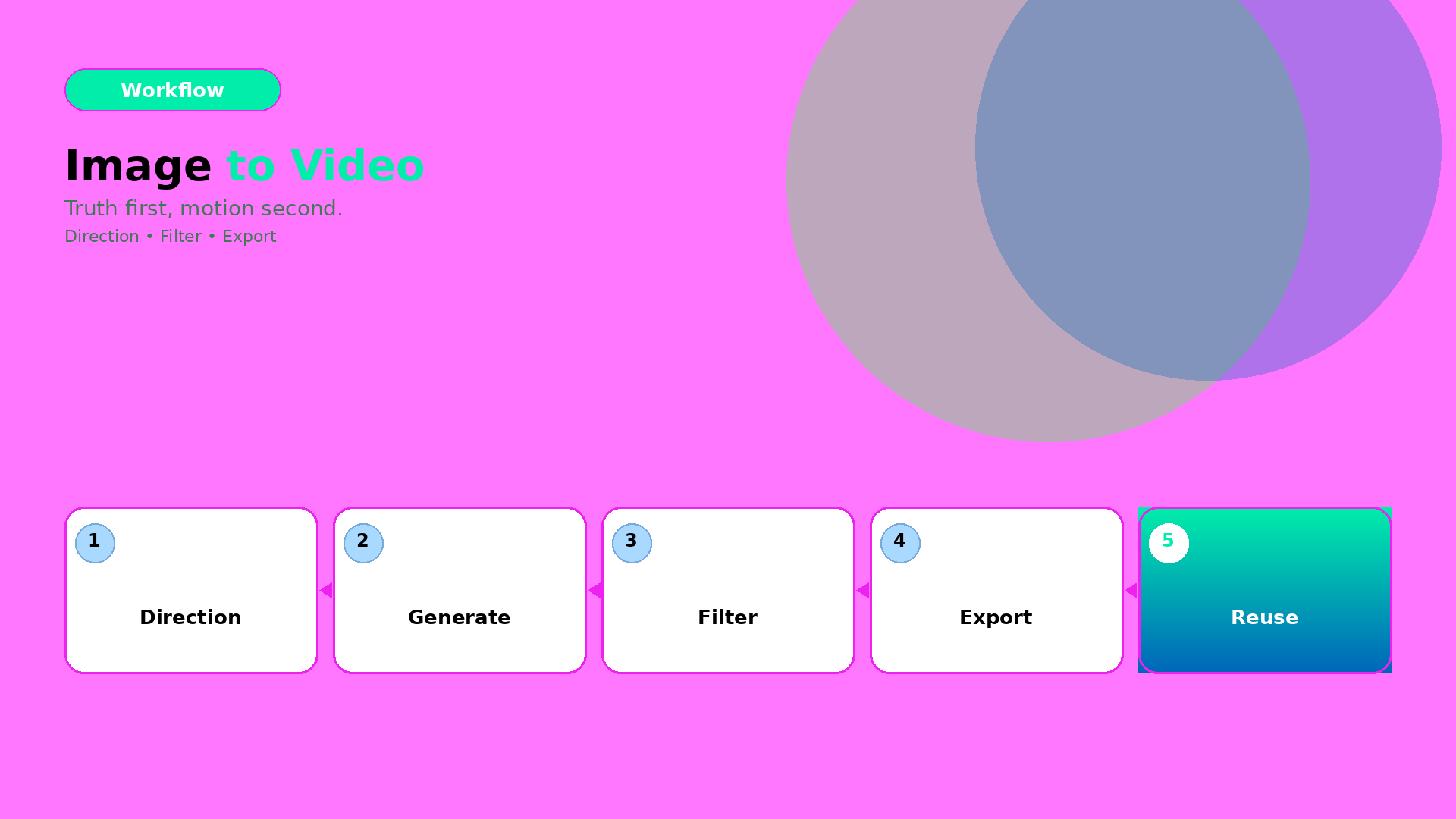
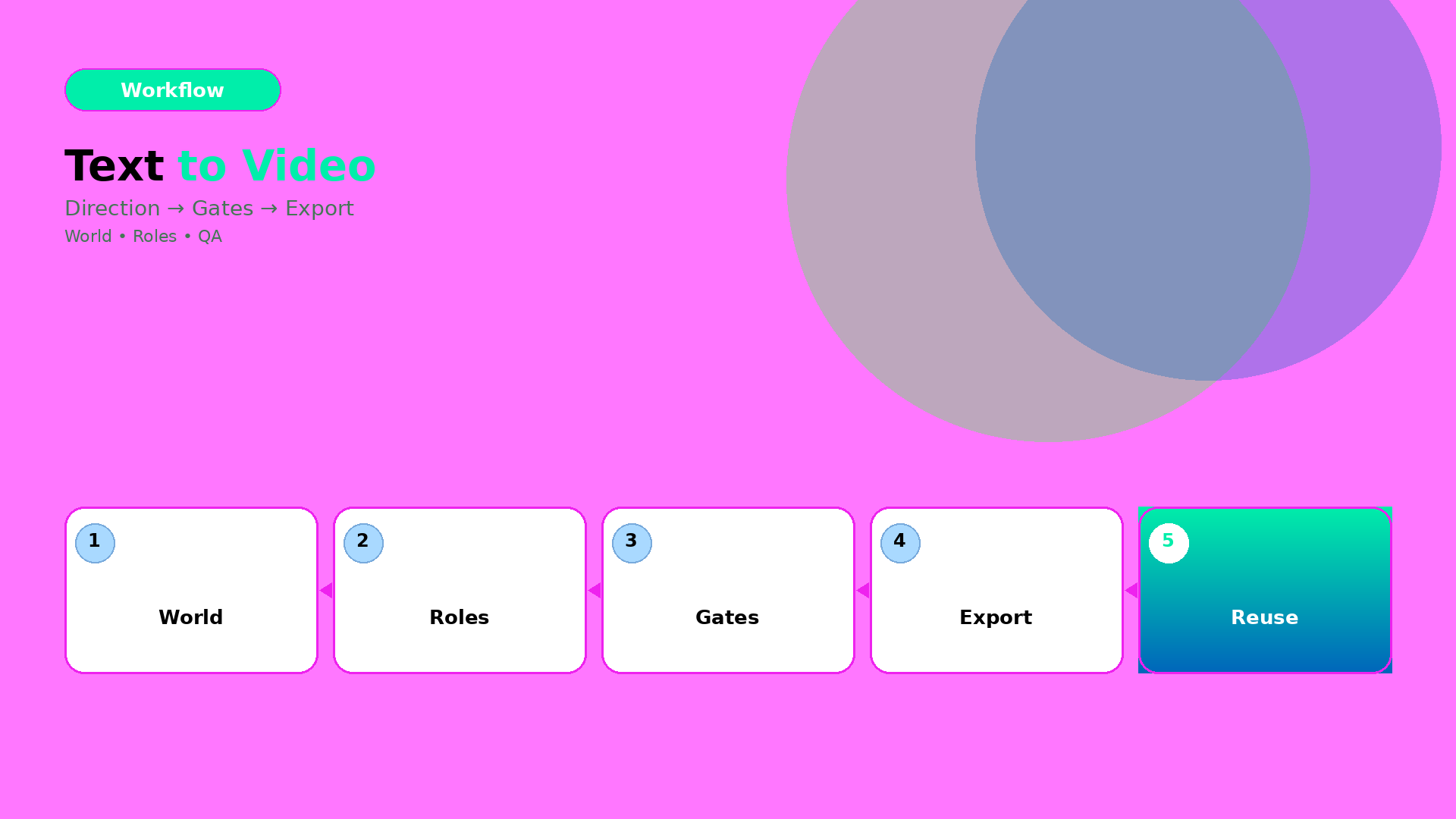
  • How to Use Image to Video with AI: Direction → Gates → Export

    How to Use Image to Video with AI: Direction → Gates → Export

    Image-to-video is deceptively easy.

    You convert one image, and you get motion. But production quality depends on one question:

    Did the direction preserve product truth?

    If yes, motion becomes proof. If no, motion becomes distortion.

    Key Takeaways

    – Image-to-video is efficient when you lock direction first.

    – Gates decide winners: geometry truth, identity stability, and caption/offer alignment.

    – Export variants should follow the same gate logic across channels.

    The 3-part workflow

    1) Direction kit (lock what must stay true)

    Define:

    • what moves (pose/camera feel),
    • what stays true (geometry, label readability, character identity cues),
    • what the scene must communicate (hook, proof, offer).

    This is the “creative direction” layer. Not another prompt.

    2) Generate candidates (then filter, fast)

    Generate multiple candidates under the same direction kit. Reject early with gates:

    • warped edges / warped proportions,
    • unstable identity cues,
    • text/label unreadability after resize.

    This prevents spending time on polish for failures.

    3) Export channel-safe variants (without rework)

    Export with rules:

    • correct aspect ratio,
    • stable safe zones for text and CTA,
    • consistent shadow family and background logic.

    Now your output becomes a reusable creative asset, not a one-off clip.

    What to do next

    If you want the deeper version of the same workflow, read:

    And if your bottleneck is “not enough angles”:

  • How to Convert Text to Videos with AI: Bottleneck-First Workflow

    How to Convert Text to Videos with AI: Bottleneck-First Workflow

    The common failure pattern in text-to-video is the same:

    People generate early, then discover late. They refine prompts while the world already drifted.

    The production fix is simple: stop treating text-to-video as a “prompt task”. Treat it as a workflow with gates.

    Key Takeaways

    – Text-to-video works when you lock direction before you generate.

    – The right QA gates prevent world drift (tone, shadow family, and identity continuity).

    – Efficiency improves when you route by bottleneck: geometry vs readability vs offer tone.

    Step 1: Turn text into direction (not a prompt)

    Start with one compressed direction brief:

    • World: the setting + light family + tone
    • Roles: what each scene must do (hook, proof, offer)
    • Constraints: what cannot drift (product truth, identity anchors, claim safety)

    If your direction brief can’t be spoken in 20–30 seconds, your video will splinter.

    Step 2: Generate under gates (batch, then filter)

    Generate more than you need. But do not “pick the best-looking”.

    Filter by pass/fail gates:

    1. World gate: does the light/tone stay consistent?
    2. Identity gate: does the character/product identity stay in range?
    3. Offer gate: does the visual imply the same promise as your copy?

    Any failure means you update the direction kit—not your luck.

    Step 3: Export variants channel-safe

    Text-to-video videos often die at export:

    • captions get cut
    • safe zones break
    • aspect ratio changes product proportions

    So export with the same gate logic:

    Channel Gate focus
    Reels (9:16) first-second readability
    Stories caption timing and proof hold
    Feed (1:1 / 4:5) product truth center framing

    Routing: which bottleneck decides your workflow?

    Use bottleneck-first routing:

    • if geometry is failing → choose direction/scene constraints that preserve edges and proportions,
    • if readability is failing → adjust label/typography rules before generation,
    • if offer tone is failing → align caption gate with scene roles.

    Model choice is downstream.

    What to do next

    If you want the workflow mindset:

  • The Consistency Trap: Beautiful AI Images, Broken Brand

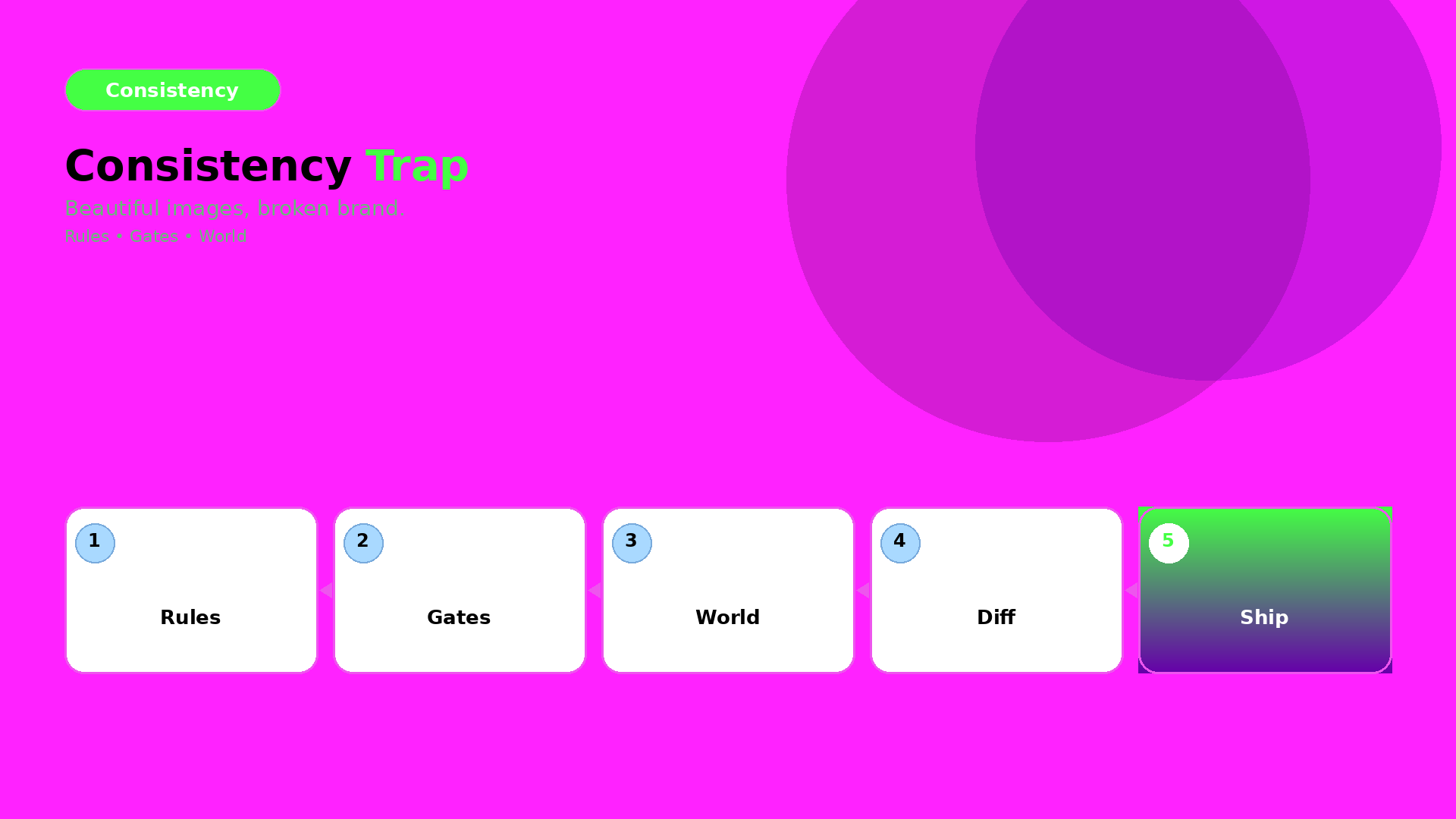
    The Consistency Trap: Beautiful AI Images, Broken Brand

    Consistency is the one thing AI can’t “handle for free”.

    It can generate a beautiful frame every time. But your audience doesn’t buy frames. They buy recognition.

    And recognition only happens when your brand’s rules survive across scenes, formats, and drops.

    Key Takeaways

    – The consistency trap is thinking “pretty” equals “aligned”.

    – Visual identity needs rules (what must not change) and gates (how you verify it).

    – World kits turn many outputs into one recognisable brand.

    What the trap looks like (in production)

    You ship a lookbook or a set of ecommerce creatives.

    Everything looks fine… until:

    • faces feel slightly different across images,
    • shadows change style between scenes,
    • product texture looks inconsistent after resizing,
    • your captions promise a different “why” than the visuals show.

    Each issue is small. Together they train buyers to doubt the brand.

    The real cause: missing “brand rules”

    Most teams don’t define rules. They define prompts.

    Prompts are flexible. Rules are strict.

    If your workflow has no strict rules, the model will “solve” each output independently. That creates drift.

    Build a consistency system: Rules → Gates → World

    1) Rules (what must not change)

    Pick a small set of invariants:

    • face/character identity anchors (identity range, hair silhouette, skin tone logic),
    • texture/label clarity rules (what makes the product “real”),
    • shadow and light family (shadow style + color temperature range),
    • typography and CTA style (if text appears, it must follow the same rules).

    Rules define “identity space”. Everything outside that space gets rejected.

    2) Gates (how you verify identity quickly)

    Use QC gates that catch drift early:

    • geometry truth gate: edges + proportions within range,
    • readability gate: label/CTA still readable after resizing,
    • world gate: light family matches kit constraints,
    • promise gate: copy tone matches the visuals’ implied offer.

    Gates are checklists, not opinions.

    3) World kit (how rules become repeatable outputs)

    World kit is your consistency contract:

    • same world logic across scenes,
    • same role structure (hook / proof / offer),
    • the same routing rules for which model to use when bottlenecks change.

    Once your world kit exists, you can scale without losing recognition.

    What to do next

    Start with one brand rule set and one world kit:

    • lock identity anchors,
    • define light family,
    • build QC gates,
    • then generate and export.

    If you want supporting frameworks:

  • Fake Studio vs Lifestyle AI Ads: Where to Draw the Line

    Fake Studio vs Lifestyle AI Ads: Where to Draw the Line

    AI makes it easy to generate “studio shots”.

    But studio shots are not a guarantee of trust.

    Sometimes the right world is the fake studio.

    Sometimes the right world is real lifestyle.

    The framework is simple:

    You do not choose by aesthetics. You choose by world truth—what the buyer expects before they decide.

    Key Takeaways

    – Fake studio is not “bad”. It is a tool with a job slot.

    – Lifestyle works when the offer depends on context and ritual.

    – QC is not “pretty”. QC is whether the scene keeps the same world promise.

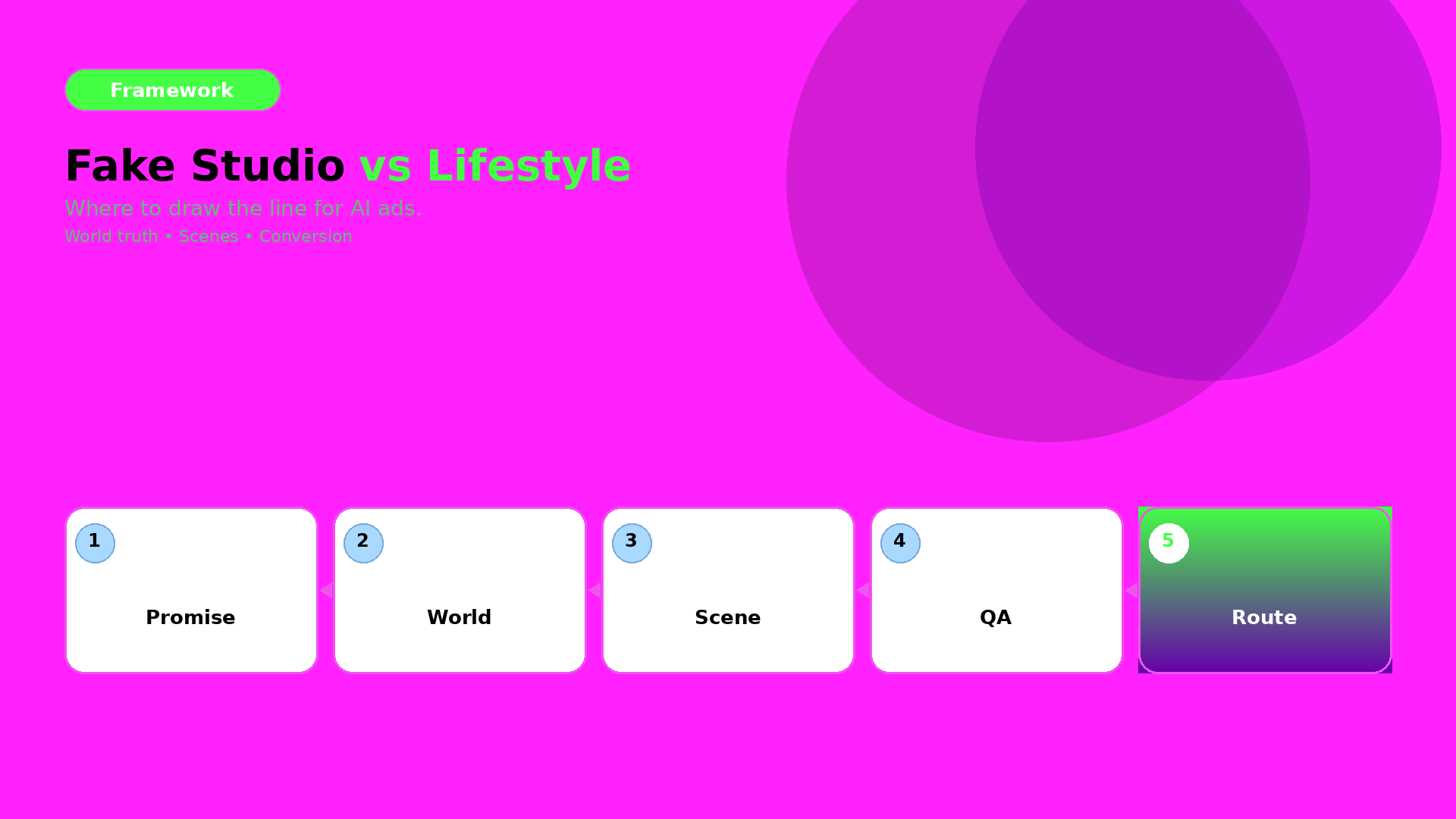
    The decision framework (Promise → World → Scene)

    1) Promise (what you are trying to sell)

    Ask: what does the buyer need to believe?

    • Geometry truth (fit, labels, texture)? → studio-like proof frames can work.
    • Ritual truth (how it is used, felt, timed)? → lifestyle wins.

    2) World (the continuity system)

    World includes:

    • light family (shadow style and temperature),
    • background logic (real-world coherence),
    • and tone (premium, calm, energetic).

    If world rules are missing, both studio and lifestyle outputs drift.

    3) Scene roles (assign responsibilities)

    Scenes should have roles:

    • hook frame (value instantly),
    • proof frame (product truth),
    • offer close (CTA + tone).

    When you assign roles, you can mix studio-like proof with lifestyle context without contradiction.

    QC gates: how you prevent the “it feels wrong” moment

    Use gates that catch world mismatch:

    1. Shadow family gate: does the shadow style match the kit across scenes?
    2. Texture truth gate: do labels and textures stay readable after resizing?
    3. Context coherence gate: does the lifestyle setting make sense for the product’s promise?
    4. Offer tone gate: does the caption imply the same promise as the visuals?

    If one gate fails, you update the world kit. You do not “regenerate until it looks better”.

    What to do next

    Start with lifestyle context mapping for beauty and ritual-driven offers:

    Then expand the same framework to any category with:

    • proof frames (studio-like),
    • and story scenes (lifestyle-like).
  • AI Lookbook World Building: Narrative Systems for Drops

    AI Lookbook World Building: Narrative Systems for Drops

    AI doesn’t break lookbooks because it’s “bad at images”.

    It breaks lookbooks because it treats every scene as a standalone moment.

    World-building fixes this by making every scene belong to the same fictional—and commercial—world.

    Key Takeaways

    – A lookbook world is a continuity system: rules that survive across scenes.

    – World-building turns “many images” into a repeatable drop calendar.

    – QA becomes measurable when you test continuity, not vibes.

    What is “lookbook world building”?

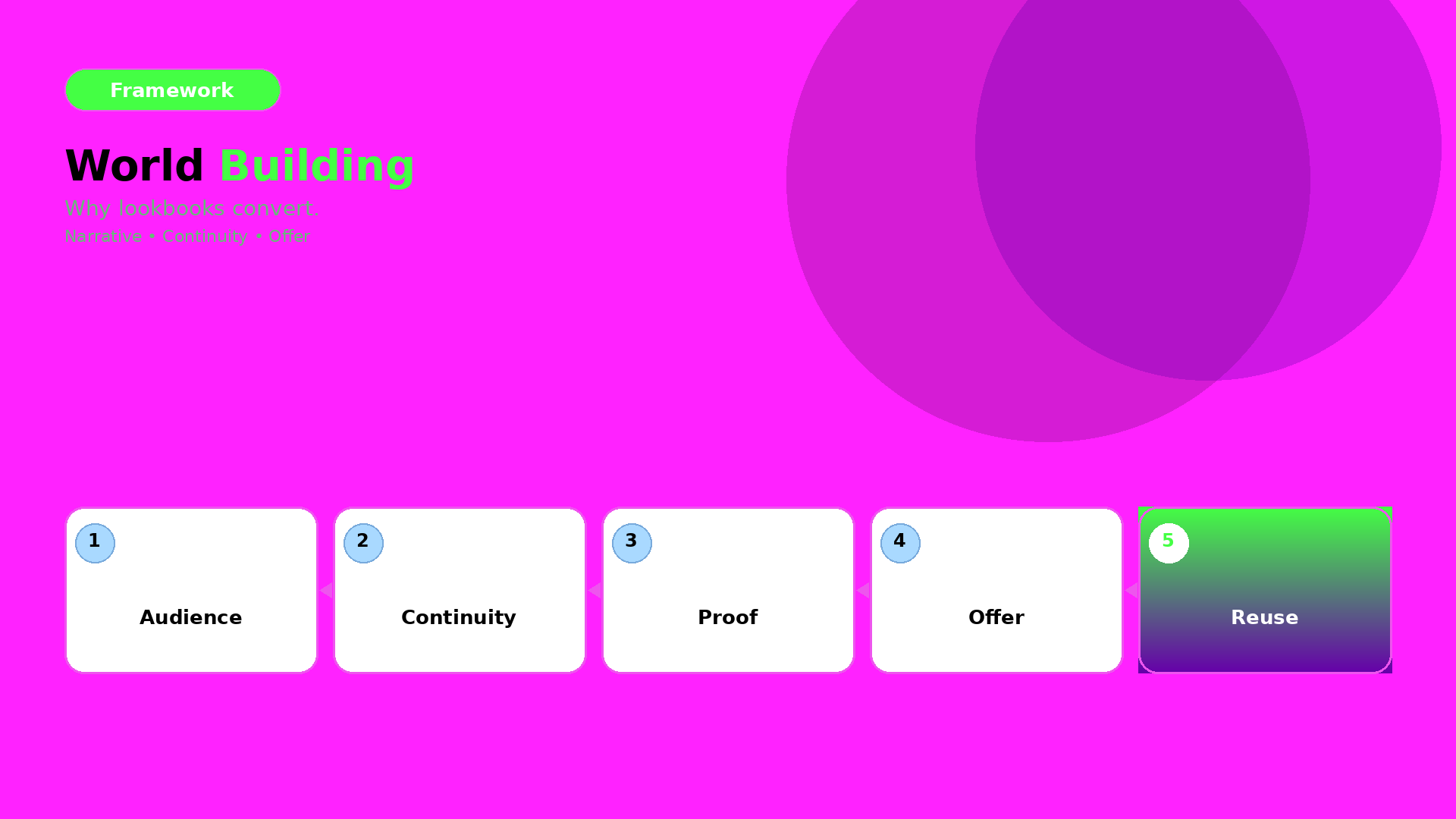
    World-building is the layer that defines:

    1. Continuity (what must stay identical)
    2. Scene roles (what each scene is responsible for)
    3. Offer repetition (how the buyer gets the same message safely)

    In production terms:

    • World rules create stability (light family, palette logic, texture truth)
    • Scene roles create clarity (hook frame, proof frame, offer close)
    • Offer repetition creates conversion consistency (CTA + claim tone)

    Why AI needs world rules (not just prompts)

    When you don’t define world rules, you get:

    • random shadow styles per scene,
    • character drift (face, hair, identity cues),
    • geometry “almost-right” that buyers feel as uncertainty,
    • captions that imply different promises in different formats.

    World rules are your answer.

    A simple world kit you can reuse

    Lock a small kit once, then reuse it:

    • Light family: morning-soft, editorial-hard, or evening-warm (pick one logic)
    • Palette logic: background tones and product accent colors stay within a range
    • Continuity anchors: product geometry, label readability, character silhouette
    • Claim safety rules: what you can promise repeatedly without overclaiming

    This is not an aesthetic moodboard. It is a set of constraints.

    Scene roles: assign responsibilities, not random scenes

    Use scene roles like a checklist:

    • Hook role: first frame tells value
    • Proof role: texture + details that justify claims
    • Offer role: CTA and close promise
    • Reuse role: later scenes that can be resized into ads without contradiction

    When every scene has a role, the drop feels like a system—not a scatter.

    QA gates (how you prevent world collapse)

    Before you export, verify:

    • Continuity anchors still match (identity + geometry range)
    • World light stays inside the light family
    • Offer tone stays consistent with the campaign claim

    If one gate fails, update the world kit—not the entire pipeline.

    What to do next

    Start by turning your lookbook into roles:

    • build 1 world kit,
    • generate 3 scenes,
    • run QA gates,
    • then scale to a full drop schedule.

    If you want the scene workflow, pair this with:

  • Lookbook Thinking: 5 Creative Directions Without a Studio

    Lookbook Thinking: 5 Creative Directions Without a Studio

    Most lookbooks fail with AI for one simple reason:

    They start from images instead of directions.

    Directions are your brand’s continuity contract. Once directions are locked, scenes become repeatable production jobs—not random aesthetic roulette.

    Key Takeaways

    – A lookbook needs creative directions (world + roles), not more variations.

    – Lock 5 directions, then map scenes, channels, and formats to the same world kit.

    – QA is not “does it look pretty?” QA is “does the world stay consistent?”

    What is a creative direction in a lookbook?

    A creative direction answers three questions:

    1. What is the world? (setting, light family, mood)
    2. Who are the roles? (character identity, behavior rules)
    3. What is the offer? (what the buyer should feel and do)

    Without roles, AI drifts. Without world rules, the drop looks like different seasons.

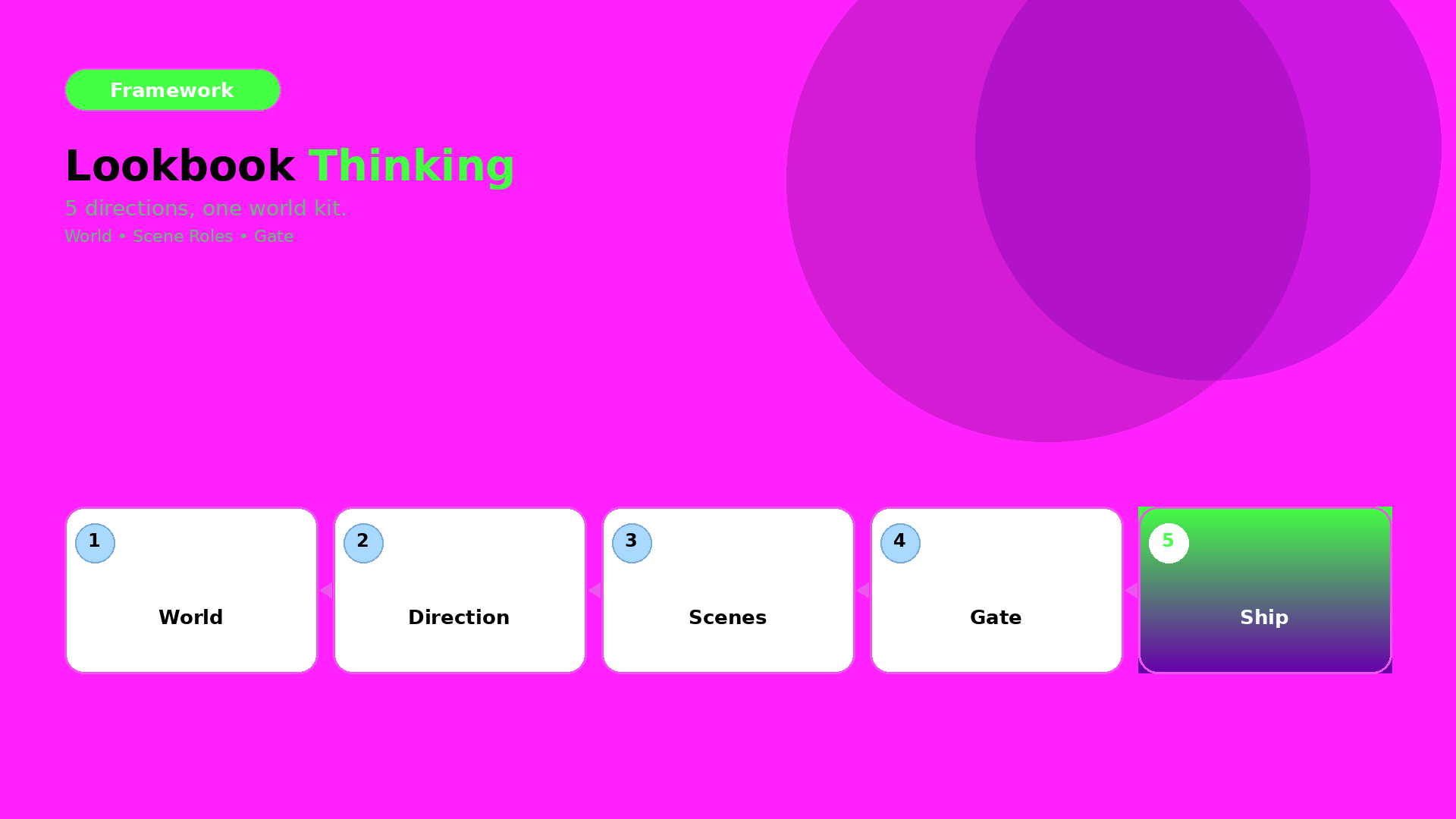
    The 5 directions that sell (and reuse easily)

    1) The Everyday Ritual

    Product as a habit. Calm pace, honest texture, soft proof.

    Use it for: skincare routines, casual apparel, “wear it daily” offers.

    2) The “Reveal” Story

    Before/after movement. The first frame must communicate the value instantly.

    Use it for: seasonal upgrades, styling transformations, upgrade-to-new-version messages.

    3) The Social Proof Frame

    Receipts before claims. Strong composition, minimal clutter, credible atmosphere.

    Use it for: bundles, limited drops, “most ordered” positioning, trust-building pages.

    4) The Location Mood

    Same product identity, different narrative location.

    Use it for: city traveler looks, vacation capsule wardrobes, lifestyle fit moments.

    5) The Product Truth Close

    Geometry and details first. Tight proof for texture, stitching, labels, and fit cues.

    Use it for: e-commerce PDP support, reseller listings, marketplace creatives.

    How do you apply directions to scenes?

    Treat each direction as a scene role template:

    • World rules stay stable (light family, palette logic)
    • Role rules stay stable (character identity, behavior)
    • Only the scene variable changes (location, outfit item, action)

    This is the same mindset behind:

    QA gates: what to check before you ship

    If you want directions to hold across formats, your QA checklist must include:

    • facial identity continuity (jawline, skin tone range, hair silhouette)
    • product geometry truth (no warped edges, stable label readability)
    • world continuity (shadow style and color temperature stay inside the kit)
    • offer continuity (CTA and claim tone match the direction’s “why”)

    What to do next

    If you’re planning a weekly drop, start with the smallest win:

    Lock one direction, generate 6–10 scenes, and enforce the QA gates.

    Then scale to five directions once your world kit passes.

  • Moodboard Before Render: Why Designers Still Need This Step

    Moodboard Before Render: Why Designers Still Need This Step

    Moodboard Before Render: Why Designers Still Need This Step

    The fastest way to waste an afternoon with AI is to skip the slowest step: the moodboard.

    Teams open an image model, type "premium lifestyle product shot," generate twenty variations, pick three they like, and discover on Friday that marketing needs eight more scenes in the same world — and none of the new renders match Tuesday's winners. The model did not fail. The moodboard gate did.

    An AI moodboard workflow is not nostalgia for pre-digital art direction. It is the pre-render contract — light temperature, palette, emotional register, composition habits — that turns exploration into a system you can scale.

    Key Takeaways
    >
    > – Moodboard before render = lock direction before pixels. Without it, AI exploration produces orphans, not campaigns.
    > – Adobe's 2026 Creators' Toolkit Report: 57% say AI outputs need moderate or extensive editing before publish — much of that editing is unfixed direction, not bad models (Adobe, 2026).
    > – A working moodboard answers four questions: What light? What palette? What feeling? What composition habits?
    > – Moodboard is the bridge between explore mode and reference-heavy scale.
    > – Skilled designers still moodboard — especially when AI is the camera (lookbook thinking).

    If you have read When to Use Reference Images vs Let AI Explore, you know exploration and scale are different modes. The moodboard is what you lock when exploration ends — the artifact that says: this world, not those twenty other worlds we tried.

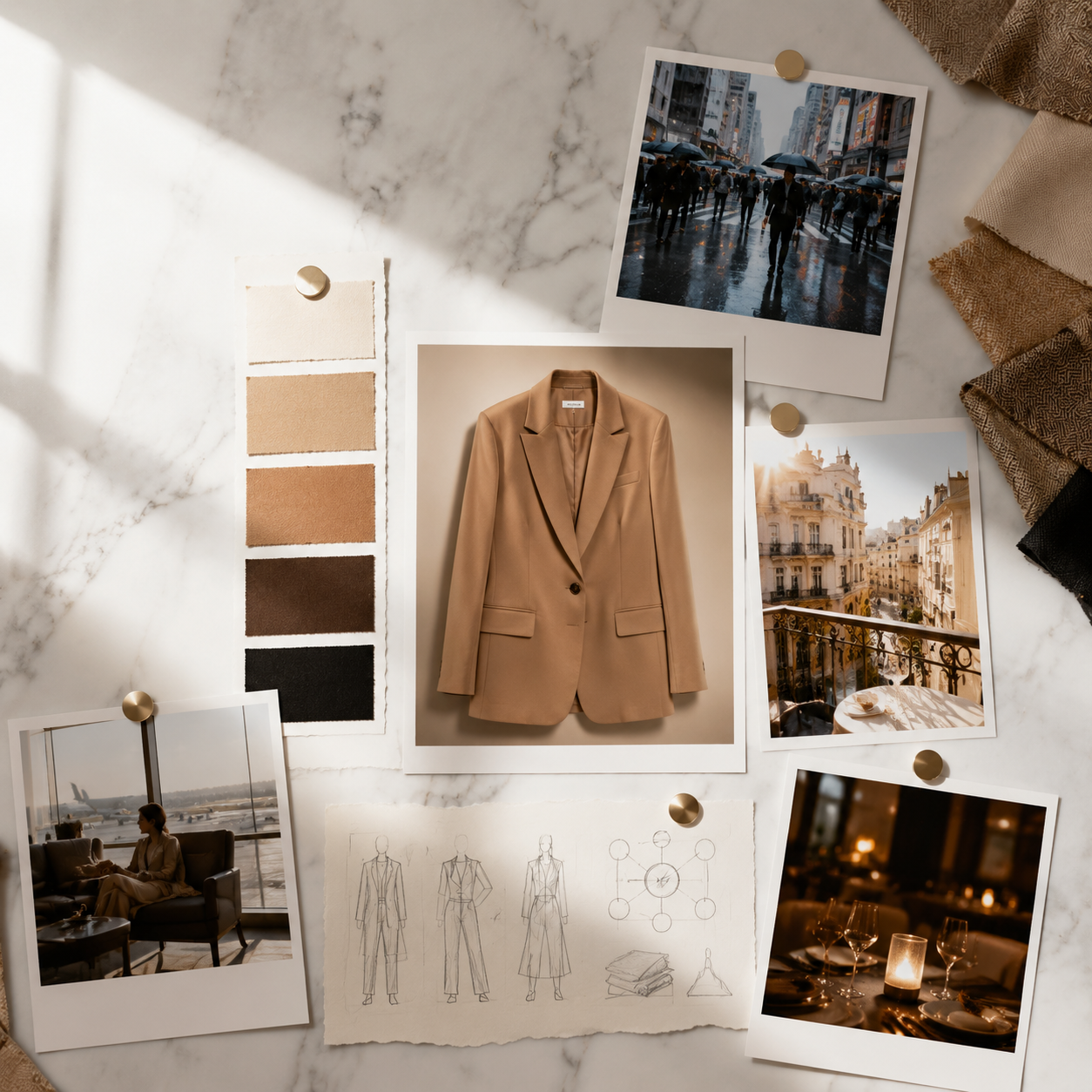
    Fashion art director moodboard with color swatches lifestyle references and product hero frame before AI render

    What Is a Moodboard in an AI Creative Workflow?

    A moodboard in 2026 is not a Pinterest dump. It is a directional lock — typically 5–12 frames that define:

    Dimension What the moodboard locks What it prevents
    Light Time of day, temperature, direction, hardness Random neon vs soft window drift
    Palette Dominant hues, accent rules, neutrals SKU 40 in a different color universe
    Emotion Calm, urgency, aspiration, intimacy Mixed emotional registers in one gallery
    Composition Distance, crop, product-to-frame ratio Inconsistent scale across scenes
    Environment type Kitchen, commute, bathroom — not specific props Stock photo roulette

    The moodboard does not need to include your product. It often should not. It defines the world; product references attach separately in reference mode.

    Why Did Teams Think AI Made Moodboards Optional?

    Three myths enabled the skip:

    1. "The prompt is the brief." Prompts describe one frame. Moodboards describe a family of frames — the visual dialect every scene must speak.

    2. "We will fix it in post." Adobe reports 57% of AI outputs need meaningful editing before publish (2026). Post fixes one image. It does not fix a catalog that drifted across fifty SKUs.

    3. "Exploration is the deliverable." Exploration finds options. The deliverable is a curated set in one world — the lesson from our eight-scene experiment.

    What Belongs on a Pre-Render Moodboard?

    Minimum viable moodboard (5 frames)

    1. Light reference — one frame defining temperature and direction
    2. Palette anchor — swatches or a scene with correct dominant hues
    3. Environment type — the room/street/shelf logic, not luxury clichés
    4. Emotion reference — one frame that nails the feeling (calm, energy, intimacy)
    5. Composition habit — distance and crop logic for the batch

    Extended moodboard (8–12 frames)

    Add: negative references (what to avoid), texture/material examples, character/talent tone if applicable, and one hero product placement sketch — not a final render, a layout intention.

    Pair the moodboard with a 3-line brief:

    Flat lay of design moodboard materials color swatches and reference photos on desk
    Brief line Moodboard expression
    Line 1 Buyer Emotion + environment type frames
    Line 2 World Light + palette frames
    Line 3 Close Composition + channel-intent frame

    Then expand into SCENE rows — each row must pass the moodboard test: could this scene exist on the same film day as frame 3?

    Creative workspace with printed reference images color swatches and laptop for AI moodboard workflow

    Where Does Moodboard Sit in the Pipeline?

    BRIEF (3-line) → MOODBOARD (lock world) → SCENE MAP → EXPLORE (test) → CURATE → REFERENCE MODE (scale)
    Stage Moodboard role
    Before explore Define boundaries — what worlds are in play
    After explore Select 5–8 winners that become the locked board
    Before batch Attach as reference anchors alongside product shots
    During QA Reject any render that breaks board light or palette
    On drift recovery Return to board — not random prompt edits (brand trap)

    This is Direction 2 from lookbook thinking: moodboard before render — lock temperature, palette, and emotional direction before AI exploration scales.

    How Do You Build a Moodboard in One Working Session?

    Step 1 — Write the world sentence (10 minutes)

    One sentence: "Urban autumn morning, soft window light, warm neutrals, unhurried confidence." If you cannot write it, you are not ready to render.

    Step 2 — Collect references (20 minutes)

    Pull 10–15 candidates from past shoots, brand archives, licensed stock, or approved AI exploration frames. Do not render new images yet.

    Step 3 — Curate to five (15 minutes)

    Kill frames that disagree on light or palette. The board should feel like one photographer's afternoon, not a design trend collage.

    Step 4 — Add negatives (5 minutes)

    List 3–5 visual habits to reject: marble bathrooms, gold fixtures, neon gradients, oversaturated skin, floating products with no shadow logic.

    Step 5 — Sign-off gate (5 minutes)

    Explorer and curator (or client) agree: this board is the world. No batch runs until sign-off.

    Total: under one hour. Cheaper than regenerating forty wrong scenes.

    What Breaks When You Skip the Moodboard?

    Skip symptom Root cause Fix
    Pretty orphans No shared world Moodboard gate
    Palette drift mid-batch No palette anchor Lock swatches on board
    Inconsistent light Explored without boundaries Light reference frame
    Client "something feels off" Emotion not agreed Emotion frame + brief Line 3
    Brand consistency trap No recovery anchor Rebuild board from 3 winners only

    When drift appears, do not tweak prompts randomly. Return to the moodboard and ask which dimension broke: light, palette, emotion, or composition.

    Split comparison of chaotic AI image grid versus curated moodboard-directed scene family

    How Does Moodboard Connect to Catalog Scale?

    For 100-SKU batches, the moodboard is per scene family, not per SKU:

    Scene family Moodboard scope
    Morning ritual One board for all bathroom/shelf SKUs
    Desk pause One board for homeware + drinkware
    Travel kit One board for minis and pouches

    Swap product references; do not swap worlds mid-family. That is how batch thinking preserves soul at scale.

    Moodboard vs Brand Style vs References — What Is the Difference?

    Artifact Job
    3-line brief Strategic decisions — buyer, world, close
    Moodboard Visual lock — light, palette, emotion, composition
    Brand Style (tool layer) Enforced rules in generation pipeline
    Product references SKU truth — shape, label, color accuracy
    SCENE grid Per-scene commercial mapping

    The moodboard is the human-readable version of what Brand Style encodes in software. Both should agree — if they diverge, trust the signed-off board.


    Lock direction before render on Orauria: Try Orauria

    Frequently Asked Questions

    Do I still need a moodboard if I have Brand Style presets?

    Yes. Brand Style enforces rules; the moodboard chooses which world this job lives in. Presets without direction still drift.

    Can the moodboard be AI-generated images?

    Yes — if they are curated exploration winners, not random generations. Exploration produces candidates; moodboard locks the selection.

    How many frames is enough?

    Five for a minimum viable board. Eight to twelve for complex fashion or multi-channel campaigns.

    How long should moodboarding take?

    Under one hour for most ecommerce jobs. If it takes days, the brief is not decided yet — fix 3-line brief first.

    Is moodboard only for fashion?

    No. Beauty needs ritual environments. FMCG needs desk and shelf worlds. Any SCENE-driven job benefits from pre-render lock.

    When can I skip the moodboard?

    Single-frame exploration with no scale intent — mood discovery only. The moment you need a set, the board returns.

    Conclusion

    AI did not retire the moodboard. It relocated it — from wall pin-up to pre-render gate in every pipeline that ships more than one image.

    Write the world sentence. Curate five frames. Sign off before the batch. Let SCENE and references do the rest.

    Designers who still moodboard are not clinging to the past. They are refusing to pay for direction drift in pixels — one render at a time, one hundred SKUs at a time.


    References

    1. Adobe, 2026 Creators' Toolkit Report, June 16, 2026. https://news.adobe.com/news/2026/06/creators-toolkit-report-2026
    2. Adobe, Inaugural Creators' Toolkit Report (Adobe MAX 2025), October 28, 2025. https://news.adobe.com/news/2025/10/adobe-max-2025-creators-survey
  • When to Use Reference Images vs Let AI Explore

    When to Use Reference Images vs Let AI Explore

    When to Use Reference Images vs Let AI Explore

    Every AI creative project starts with the same fork in the road. Lock the references — product geometry, model face, brand palette — and generate variations that stay on brief. Or open the exploration — let the model search for worlds, moods, and scenes you have never visualized before.

    Choose wrong and you waste a week. Reference-heavy when you needed discovery produces safe, boring sameness. Exploration-heavy when you needed continuity produces gorgeous drift — twelve images that do not belong to the same brand.

    This is a decision guide, not a tool tutorial. By the end you will know which mode your brief requires, how to blend both, and where each fits in lookbook thinking and AI ecommerce design.

    Designer desk with laptop and creative workspace — reference versus exploration
    The fork: lock what must stay true, or search for worlds you have not visualized yet.

    Key Takeaways

    • Reference-heavy when continuity is the brief: same face, same product, same brand silhouette across formats.
    • Exploration-heavy when the world is unknown: new season, rebrand, first lookbook, pitch mood discovery.
    • Adobe's 2025 survey found 85% of creators would consider AI that learns their creative style — because consistency is harder than first render (Adobe MAX 2025, 2025).
    • The best pipelines explore first, reference second for new lines — and reference first, explore never for SKU scale.

    What Is the Difference Between Reference Images and Open Exploration?

    Reference images anchor generation. You upload product shots, model faces, moodboard frames, or brand examples — and the AI is constrained to respect them. Shape, color, character, composition habits travel downstream.

    Open exploration removes anchors. You describe worlds, emotions, and contexts — and the AI searches broadly. Discovery is the goal. Consistency is deferred until something worth protecting appears.

    Mode Primary question Risk Reward
    Reference-heavy "Keep this exact truth across scenes" Safe, repetitive if over-constrained Scale without drift
    Exploration-heavy "What world could this product inhabit?" Aesthetic drift, orphans Breakthrough mood, new direction
    Blended "Find the world, then lock it" Process discipline required Best of both

    In 2026, Adobe found 85% of creators insist the final creative decision must remain theirs (Adobe Creators' Toolkit Report, 2026). References and exploration are inputs. Curation is still the human job.

    When Should You Use Reference Images?

    Use references when the brief has a continuity requirement — something that must not change between outputs.

    Reference-heavy scenarios

    Scenario What to reference Why
    SKU scaling Product packshots, label details Bottle shape cannot drift across 50 SKUs
    Character-led campaigns Model face, posture rules Same person across 12 formats
    Campaign extension Prior season hero frames New scenes must match established world
    Marketplace compliance Approved hero angle Main image must match listed product
    Brand refresh (partial) Logo, palette, typography rules Evolution, not reinvention

    If your SCENE map has eight contexts for one product, references protect product geometry and character while contexts change around them. That is the core of the eight-scene experiment: explore scenes, reference the outfit.

    What to upload as references

    • Product truth pack — phone or studio shots showing honest shape and color
    • Character sheet — face, hair, posture language (if human-led)
    • Moodboard anchors — 3–5 frames locking light temperature and palette
    • Brand Style rules — hex codes, forbidden tones, composition habits

    References are not for copying. They are for constraining drift.

    Creative workspace moodboard with color swatches and reference frames
    Reference mode: moodboard anchors lock light, palette, and composition before batch generation.

    When Should You Let AI Explore?

    Use open exploration when the brief is discovery — you do not yet know the world, and premature locking would kill the idea.

    Exploration-heavy scenarios

    Scenario What to explore Why
    New season / new line Worlds, contexts, emotional range No established visual language yet
    Rebrand pitch 3–5 divergent directions Client needs options, not one safe path
    First lookbook ever Buyer moments, lifestyle contexts Lookbook thinking starts here
    Mood discovery deck Light, palette, environment Pre-committed moodboard does not exist
    Creative reset Break aesthetic rut References would reinforce the old world

    Adobe's 2025 data shows 48% of creators use creative AI for ideation and brainstorming, while 52% use it for generating new assets (Adobe MAX 2025, 2025). Exploration and production are different jobs. Assign them explicitly.

    Exploration rules that prevent chaos

    1. Time-box — 90 minutes of open generation, then stop
    2. No approval during exploration — explorer role only
    3. Cluster outputs — group by mood, not by prettiness
    4. Pick one cluster — curator chooses direction
    5. Then switch to references — lock what won

    Exploration without a gate produces folders of orphans. The gate is a moodboard decision, not a model upgrade.

    Analytics dashboard showing multiple creative data variants — exploration phase
    Exploration phase: cluster outputs by mood, not prettiness — then pick one direction.

    What Is the Blended Workflow (Explore → Lock → Scale)?

    Most professional pipelines use three phases:

    Phase 1: EXPLORE (open)
        → Generate 20–40 mood frames, no product yet
        → Curator picks 1 world direction

    Phase 2: LOCK (references + moodboard)
    → Upload winning frames as style anchors
    → Define Brand Style + character rules
    → Write SCENE map for hero SKU

    Phase 3: SCALE (reference-heavy)
    → Generate scene family per SCENE row
    → Adapt per channel
    → Save workflow template
    `

    This is phone-to-campaign logic for teams with studio assets — and AI ecommerce design logic for everyone: find the world, protect it, repeat it.

    Fashion moodboard with blazer hero and lifestyle polaroids — brand style lock
    Phase 2 Lock: winning exploration frames become reference anchors for scale.
    Project phase Dominant mode
    Pitch / concept Exploration
    Client approval Exploration → Lock transition
    Launch production Reference-heavy
    Catalog extension Reference-only
    Season refresh Blended (explore accents, reference core)

    Quick Decision Tree: Which Mode Is Your Brief?

    Answer three questions:

    1. Does the product or face already exist in approved assets?
    – No → Start with exploration
    – Yes → Reference the truth pack

    2. Is the commercial world already defined?
    – No → Exploration for mood and context
    – Yes → Reference moodboard + SCENE map

    3. Is the deliverable one direction or twelve matching formats?
    – One direction / pitch → Exploration OK
    – Twelve matching formats → Reference-heavy required

    Decision matrix

    Brief type Reference Explore Blend
    New fashion lookbook (season 1) Low High Medium
    Campaign extension (season 3) High Low Medium
    100-SKU beauty catalog High Very low Low
    Rebrand pitch (3 directions) Low High
    TikTok ad variant test Medium Medium High
    Character-led video series High Low Medium
    Team reviewing creative options at desk — curator decision gate
    The decision tree ends with a human gate — explorer generates, curator locks direction.

    When references fail and drift wins anyway, read Brand Consistency Trap (coming soon).

    What Are Common Mistakes With References and Exploration?

    Mistake Symptom Fix
    Reference too late Product shape wrong in all scenes Upload truth pack before scene 1
    Explore too long 200 images, no direction 90-minute time-box + cluster
    Reference moodboard only Pretty but wrong product Separate product refs from style refs
    Explore during scale Drift across SKU batch Switch to reference-only for catalog
    Same person explores + approves No taste gate Split explorer / curator roles
    No saved lock point Re-explore every Monday Document winning refs in Brand Style

    Adobe reports 57% of creators say AI outputs need moderate or extensive editing before publish (2026). References reduce fundamental failure. Editing handles polish. Do not confuse them.

    How Many Reference Images Should You Upload?

    Use case Recommended count What they cover
    Product SKU 3–5 Angles, label, scale
    Character face 2–4 Front, 3/4, expression range
    Mood / style 5–8 Light, palette, composition
    Brand kit Rules + 3 anchors Hex, type, photo habits

    More references is not always better. Conflicting references confuse the model — warm moodboard plus cool product shot plus neon brand guideline produces mush. Curate the reference set like you curate outputs.

    How Does This Connect to Brand Style and Workflow?

    References live in three layers:

    1. Asset references — product, face, specific frames
    2. Brand Style — enforceable rules (palette, light, voice)
    3. Workflow template — saved node order for repeat runs

    In workspaces like Orauria, Phase 2 (Lock) maps to Brand Style + reference upload nodes. Phase 3 (Scale) maps to saved workflows per SKU or scene batch.

    Exploration finds what to save. References protect what you saved. Workflows replay what worked.


    Explore and lock creative worlds on Orauria: Try Orauria

    Frequently Asked Questions

    Can I use reference images and exploration in the same session?

    Yes — but sequentially, not simultaneously. Explore first without product references. Once direction wins, upload references and regenerate. Mixing both at minute zero produces muddled briefs.

    Do reference images limit creativity?

    They limit drift, not ideas. You can still place a referenced product in twelve contexts via SCENE. References constrain what must stay true; SCENE defines what may change.

    What if I only have phone photos as references?

    Phone photos are valid truth packs — especially for SMEs. Clean them for reference use (phone-to-campaign), then scale scenes around them.

    When should freelancers default to exploration?

    Pitch decks, first client concepts, and rebrand directions — anywhere the client must choose a world before production locks. Bill exploration as discovery; bill reference workflows as production.

    How do I know exploration is finished?

    When the curator can write a one-sentence world definition and pick 5–8 moodboard frames without hesitation. If you cannot write that sentence, exploration continues.

    Is open exploration risky for brand reputation?

    It is risky to publish exploration outputs without curation. Exploration itself is low risk in private — publishing without a lock phase is where brands break identity.

    Conclusion

    Reference images and open exploration are not rivals. They are phases.

    Explore when the world is unknown. Reference when the world must survive scale. Blend when the season is new but the brand is not.

    The wrong question is "which mode is better?" The right question is "which mode is this brief?" — then run the pipeline that matches.


    References

    1. Adobe, Inaugural Creators' Toolkit Report (Adobe MAX 2025), October 28, 2025. https://news.adobe.com/news/2025/10/adobe-max-2025-creators-survey
    2. Adobe, 2026 Creators' Toolkit Report, June 16, 2026. https://news.adobe.com/news/2026/06/creators-toolkit-report-2026
    3. 9to5Mac, "Adobe survey: AI is helping creators grow, but not without tradeoffs," June 16, 2026. https://9to5mac.com/2026/06/16/adobe-survey-ai-is-helping-creators-grow-but-not-without-tradeoffs/
  • The SCENE Method for AI Product Storytelling

    The SCENE Method for AI Product Storytelling

    The SCENE Method for AI Product Storytelling

    Most AI product images fail for a boring reason: the prompt describes the object, not the story. "A serum bottle on a marble counter" is not creative direction. It is inventory. The shopper does not buy marble. They buy the morning ritual, the skin confidence, the version of themselves that appears in the mirror before a hard day.

    AI product storytelling is the discipline of placing a product inside believable commercial narratives — then generating images that prove the product belongs there. The SCENE method is the framework that makes those narratives repeatable across SKUs, seasons, and channels without aesthetic drift.

    Key Takeaways

    • SCENE stands for Story, Context, Emotion, Narrative, and Extension — five questions to answer before any AI render.
    • In 2026, Adobe found 57% of creators say AI outputs need moderate or extensive editing before publish. SCENE front-loads the brief so editing fixes polish, not fundamental story failure.
    • One hero product mapped through four to six SCENE contexts beats twelve random angles on a grey background — for conversion and for brand coherence.
    • SCENE works beyond fashion: beauty, F&B, home, and electronics all sell through context and emotion, not isolation.

    If you arrived from lookbook thinking, you have already seen SCENE applied to a camel blazer across four worlds. This article generalizes the method for any product category — and connects it to the larger discipline of AI ecommerce design.

    Storyboard planning for multi-scene product storytelling
    SCENE starts on paper — or in a brief doc — before any AI model opens.

    What Is the SCENE Method?

    SCENE is a pre-render framework. Before you open any image model, you answer five dimensions for each product or hero SKU:

    Letter Dimension Core question
    S Story What micro-story does this single frame tell?
    C Context Where is the product — physically and in the buyer's life?
    E Emotion What should the viewer feel in under two seconds?
    N Narrative How does this frame connect to the frames before and after it?
    E Extension What other scenes could this product inhabit without breaking character?

    In 2026, Adobe's Creators' Toolkit Report found that 87% of creators using creative AI say it has accelerated business or audience growth — yet 85% insist the final creative decision must remain theirs (Adobe Creators' Toolkit Report, 2026). SCENE is built for that reality: AI explores the scenes; humans define the story and approve what ships.

    Skincare products in bathroom morning ritual lifestyle context
    Beauty SCENE in practice: context and ritual, not sterile product isolation.

    Why Do AI Product Images Fail Without a Story Framework?

    They fail because teams confuse catalog clarity with commercial persuasion.

    Catalog clarity answers: What is this product? What are its dimensions? What color is it?
    Commercial persuasion answers: Why does this product belong in my life right now?

    Three failure modes repeat across categories:

    1. Object-first prompting. "Generate a photo of a coffee bag" produces a bag. It does not produce desire, ritual, or morning warmth.
    2. Scene without sequence. Each image is individually fine. Together they feel like a stock photo mood board — not a brand chapter.
    3. No extension plan. The team renders one hero and stops. Marketing later asks for ads, email headers, and marketplace crops — and every new prompt drifts from the original.

    Adobe's 2025 inaugural survey found 48% of creators use creative AI for ideation and brainstorming, while 52% use it for generating new assets (Adobe MAX 2025 survey, 2025). SCENE sits upstream of both: it is the ideation structure that makes generation intentional.

    How Do You Apply Each Letter of SCENE?

    S — Story: One frame, one moment

    Every product image is a frozen scene from a longer film. Name that scene in one sentence.

    • Weak: "Skincare serum product shot."
    • Strong: "First light hits the bathroom shelf; she reaches for the serum before the city wakes up."

    The story does not need drama. It needs specificity. Vague stories produce vague images.

    C — Context: Physical place + social meaning

    Context has two layers:

    • Physical: kitchen counter, gym locker, office desk, hotel bathroom
    • Social: alone, with partner, at work, preparing for an event

    A protein powder on a gym bench and the same powder on a Sunday kitchen island tell different stories — even if the product is identical.

    E — Emotion: The feeling that closes the gap

    Name one primary emotion per frame. Not three. One.

    Emotion When it works
    Calm Wellness, skincare, home
    Ambition Professional tools, fashion, tech
    Warmth Food, family products, gifts
    Playfulness Creator tools, youth brands
    Confidence Beauty, fitness, career products

    Emotion is the bridge between scroll and stop. If you cannot name it, the image will not carry it.

    N — Narrative: How frames connect

    Narrative is sequence logic. Ask: if these images were a carousel, would they feel like chapters or like shuffle mode?

    Example sequence for a reusable water bottle:

    1. Morning fill at home (hydration habit)
    2. Gym floor beside mat (performance context)
    3. Desk beside laptop (workday companion)
    4. Evening park bench (recovery wind-down)

    Same bottle. Four chapters. One product story.

    Laptop and team collaboration representing connected narrative sequence across scenes
    Narrative is sequence logic — each frame should feel like the next chapter, not shuffle mode.

    E — Extension: Plan the family before you render

    Extension prevents the "we need five more images by Friday" panic. Before the first render, list every scene the product must inhabit this quarter: PDP gallery, paid social, email hero, marketplace, seasonal campaign.

    Extension is where AI ecommerce design meets SCENE: one creative direction, many formats.

    What Does SCENE Look Like Across Product Categories?

    Beauty: Vitamin C serum

    Scene Story Context Emotion
    1 Morning ritual Bathroom shelf, soft window light Calm renewal
    2 Pre-event prep Vanity mirror, evening glow Confident glow
    3 Travel essential Hotel bathroom, compact bag Capable, cared-for
    4 Gift moment Wrapped box on linen, natural light Warm generosity

    We explore beauty-specific scene mapping in Lifestyle Context Mapping for Beauty Ads (coming soon).

    Pour-over coffee on kitchen island — Sunday morning lifestyle scene
    F&B SCENE: the story is ritual and warmth, not just the bag on white.

    Food & Beverage: Specialty coffee bag

    Scene Story Context Emotion
    1 Slow Sunday Kitchen island, pour-over setup Unhurried warmth
    2 Work-from-home Desk beside laptop, ceramic mug Focused comfort
    3 Friends over Dining table, shared pot Social connection
    4 Gift shelf Pantry display, handwritten tag Thoughtful giving

    Home: Minimal desk lamp

    Scene Story Context Emotion
    1 Late work session Home office, blue hour through window Quiet focus
    2 Reading hour Armchair, book, warm pool of light Restful intimacy
    3 Student setup Compact desk, notebook stack Ambitious clarity

    Fashion: (recap from lookbook thinking)

    The camel blazer example from Your Lookbook Doesn't Need a Studio — Monday momentum, Saturday slow, red-eye ready, after hours — is SCENE applied to apparel. Fashion is not a separate method. It is SCENE with a human character at center frame.

    How Many SCENE Contexts Should One Product Have?

    Start with four to six scenes per hero SKU. That is enough narrative range for a launch week without drowning in production.

    Product stage Recommended SCENE count
    New launch / hero SKU 4–6 scenes
    Catalog extension 2–3 new scenes per seasonal refresh
    Marketplace-only SKU 3 scenes minimum (hero clarity + 2 context)
    Full campaign drop 6–8 scenes across channels

    Adobe reports that 93% of creators say AI helps them produce content faster (Adobe Creators' Toolkit Report, 2026). SCENE channels that speed: you are not generating twenty random variations. You are filling a predetermined scene grid.

    Team planning SCENE brief at desk with laptop and notes
    A SCENE brief takes 15–30 minutes. Re-prompting orphans takes days.

    What Is a SCENE Brief Template You Can Use Today?

    Copy this before your next render session:

    PRODUCT: [name + category]
    BUYER: [who, age range, life moment]
    BRAND EMOTION: [one word — calm, ambition, warmth, etc.]

    SCENE 1
    Story:
    Context:
    Emotion:
    Narrative role: [opening / proof / desire / close]

    SCENE 2
    Story:
    Context:
    Emotion:
    Narrative role:

    [repeat for scenes 3–4]

    EXTENSION (formats needed this month):
    – PDP hero:
    – PDP gallery:
    – Paid social:
    – Email:
    – Marketplace:

    CONSISTENCY RULES:
    – Light logic:
    – Palette:
    – Character/product continuity:
    `

    This is not bureaucracy. It is the three-line brief expanded into a commercial map — the difference between prompting and directing.

    When Should SCENE Use Reference Images vs Open Exploration?

    • Open exploration when you are discovering the world: new product line, rebrand, first-season lookbook, pitch deck mood.
    • Reference-heavy when you are scaling: same bottle shape, same label details, same model face across twelve formats.

    The full decision tree lives in When to Use Reference Images vs Let AI Explore (coming soon). SCENE works in both modes — it defines what to explore or what to protect.

    What Are the Most Common SCENE Mistakes?

    Mistake Symptom Fix
    Skipping Extension Friday panic for "more assets" List formats before first render
    Emotion stacking Muddy, confused frames One emotion per scene
    Context without story Pretty location, no moment Name the micro-story in one sentence
    Narrative shuffle Carousel feels random Assign narrative role per scene
    No consistency rules Beautiful set, wrong brand Lock light + palette before batch

    When drift appears across a SCENE set, return to the brief — not the model. Read Brand Consistency Trap: 5 Times AI Broke Your Visual Identity (coming soon) for recovery patterns.

    How Does SCENE Connect to Workflow and Tools?

    SCENE is thinking, not clicking. In practice, the method maps to a repeatable pipeline:

    1. Write SCENE brief for hero SKU
    2. Build moodboard from references (temperature, palette, emotion)
    3. Generate scene variations per SCENE row
    4. Curate 1 winner per scene — kill the rest
    5. Adapt winners per channel format
    6. Save brief + workflow as template for next SKU

    For teams starting with phone photos instead of studio assets, see From Phone Photo to Campaign (coming soon). SCENE still applies — the reference image is just noisier at the start.

    In workspaces like Orauria, SCENE rows become workflow nodes: reference upload → Brand Style → scene generation → upscale/crop per format → template save. The framework survives the toolchain change.


    Map your next product story on Orauria: Try Orauria

    Frequently Asked Questions

    Is SCENE only for fashion and lookbooks?

    No. SCENE originated in lookbook thinking but applies to any product sold through context: beauty, food, home, electronics, wellness. If your buyer imagines a life around the product, SCENE applies.

    How long should a SCENE brief take to write?

    Fifteen to thirty minutes for a hero SKU with four scenes. That is less time than re-prompting twenty orphaned images and trying to make them feel related afterward.

    Can I use SCENE with only text-to-image tools?

    Yes. SCENE is model-agnostic. It defines the brief before the tool. Whether you use Flux, Midjourney, or a multi-model workspace, the five questions stay the same.

    What is the difference between SCENE and a creative brief?

    A traditional creative brief is often a document. SCENE is a grid — one row per scene, five columns, built for batch production. It is brief structure designed for AI iteration speed.

    How does SCENE help with AI product storytelling for SEO?

    Search engines and AI assistants reward content that answers buyer questions clearly. SCENE-based galleries naturally produce image sets with descriptive alt text, coherent narratives, and FAQ-friendly context — which supports both PDP engagement and topical authority posts.

    Should every scene include a person?

    Not always. Some products — food, objects, decor — tell stories through environment alone. SCENE still applies: the "character" can be the room, the table, the hands, or the light — not necessarily a full model.

    Conclusion

    AI product storytelling is not about prettier packshots. It is about evidence — proof that a product belongs in a life the buyer recognizes.

    SCENE makes that evidence systematic. Define the story before the object. Place the product in context. Name the emotion. Connect the frames. Plan the extension before the first render.

    Stop prompting products. Start directing scenes.


    References

    1. Adobe, 2026 Creators' Toolkit Report, June 16, 2026. https://news.adobe.com/news/2026/06/creators-toolkit-report-2026
    2. Adobe, Inaugural Creators' Toolkit Report (Adobe MAX 2025), October 28, 2025. https://news.adobe.com/news/2025/10/adobe-max-2025-creators-survey
    3. 9to5Mac, "Adobe survey: AI is helping creators grow, but not without tradeoffs," June 16, 2026. https://9to5mac.com/2026/06/16/adobe-survey-ai-is-helping-creators-grow-but-not-without-tradeoffs/