You generate a strong face for Tuesday’s Reel. Wednesday’s Story looks related. Thursday’s carousel looks like a cousin. By Friday’s marketplace banner, followers comment: is that a different person?
That is not a model failure. That is a design failure.
AI character consistency is not a filter you toggle after the prompt. It is character design — the same discipline animation studios and game teams use before a single frame ships. Creators who treat the face as a lucky seed will keep losing identity across formats. Creators who write a character bible first can ship the same person across twelve placements without the audience noticing the pipeline.
Key Takeaways
>
– Face consistency across formats is a character design problem, not a prompt trick. Lock identity rules before you open the generator.
– Adobe’s 2026 Creators’ Toolkit Report found 57% of creators say AI outputs need moderate or extensive editing before publish — and 42% say AI-generated work makes distinctive voices harder to surface (Adobe, 2026).
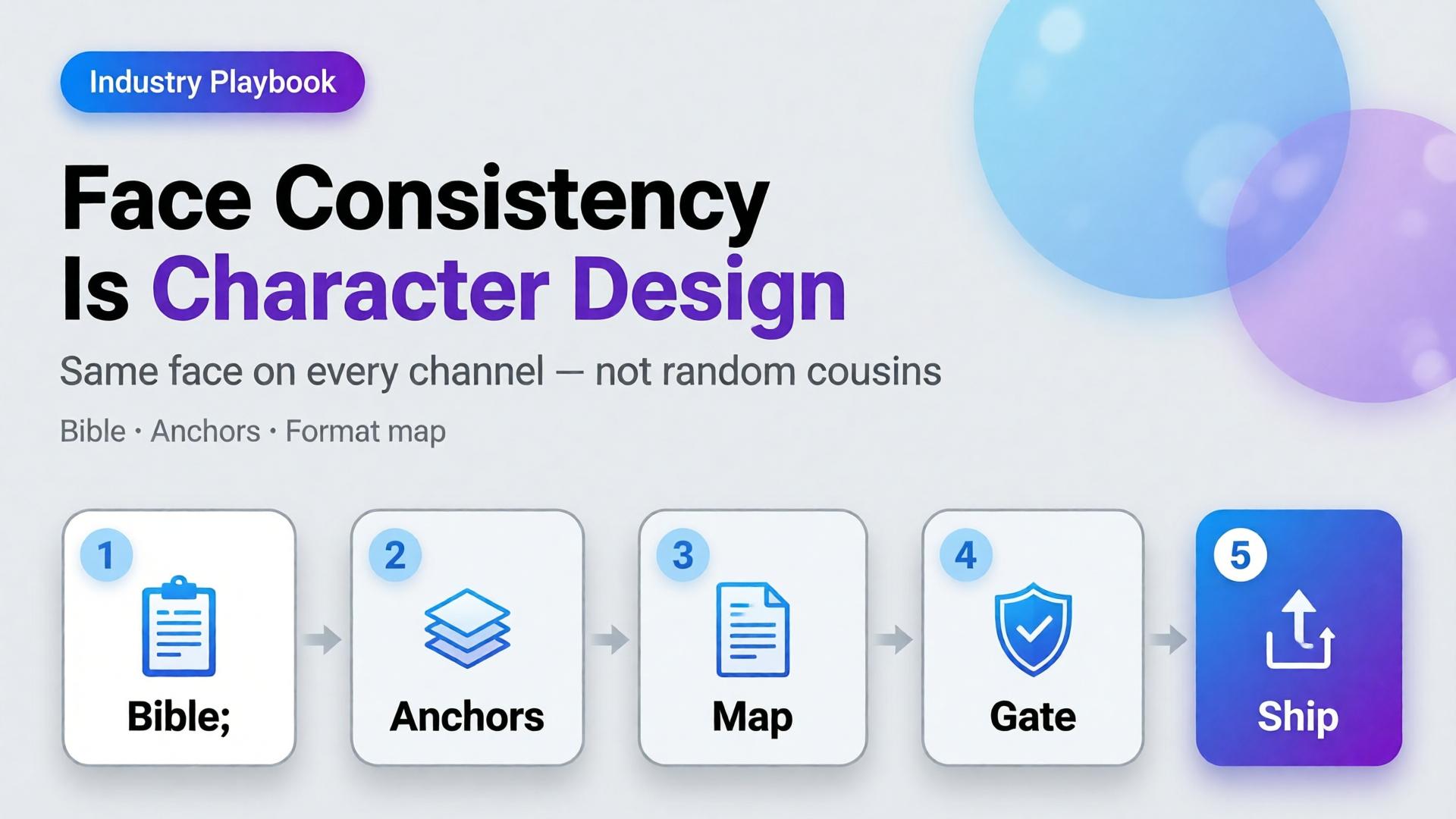
– A workable kit has three layers: character bible, reference pack, format map (12 placements, one identity).
– Curator gates beat more seeds. One approved face family scales; twenty “almost right” faces destroy trust.
This is an industry playbook for creators, KOLs, and brand teams who put a human face in front of products. If you need the failure autopsy, read Brand Consistency Trap. If you need when to lock references versus explore, read Reference Images vs AI Explore. This article answers: how do you keep one face alive across twelve formats?
Why Does Face Drift Break Creator Trust Faster Than Bad Lighting?
Lighting mistakes look amateur. Face drift looks dishonest.
Followers forgive a soft shadow. They do not forgive a jawline that migrates every post. The brain treats facial identity as a continuity contract. Break it and engagement does not just drop — recognition resets. You are introducing a new spokesperson every week without meaning to.
Creators feel this as “the model changed my face again.” The deeper issue is upstream: there was no locked character. Every generation started from vibes instead of a bible.
Audience trust for AI-assisted creators is not “was this generated?” It is “is this the same person I already know?” Face consistency is continuity, not aesthetics.
What Is Character Design for AI Creators?
Character design means deciding — in writing and in images — what must never change, what may change, and what is forbidden.
| Layer | Lock forever | Soft rules | Never do |
|---|---|---|---|
| Face geometry | Eye distance, jaw, nose bridge | Expression intensity | Age jumps, ethnicity drift |
| Hair | Base cut + color family | Styling for scene | Random length each post |
| Skin | Undertone, freckle map | Makeup level | Plastic smoothness one day, heavy pores the next |
| Wardrobe world | Signature palette | Outfit per format | Brand-clash logos |
| Age / era | Apparent age band | Season styling | Teen ↔ mid-30s oscillation |
If you cannot fill this table in ten minutes, you are not ready to batch. You are ready to explore — once — then lock.
Citation capsule: Distinctive creator voices are already under pressure. Adobe’s 2026 survey found 42% of creators believe AI-generated work makes it harder for distinctive voices to surface. Face drift accelerates that problem by dissolving the one asset audiences use to recognize you.
The 12-Format Map: Same Face, Different Jobs
Consistency does not mean identical crops. It means identical identity under different jobs.
| # | Format | Job | Face rule |
|---|---|---|---|
| 1 | Feed 1:1 | Stop scroll | Full face, strong eye contact |
| 2 | Feed 4:5 | Depth / product hold | Face + product in same plane |
| 3 | Story 9:16 | Immersion | Closer crop, same bone structure |
| 4 | Reel cover | Click | Peak expression from approved set |
| 5 | Thumbnail | Search / browse | High-contrast, readable at 120px |
| 6 | Carousel keyframe | Sequence | Same lighting family across slides |
| 7 | Live avatar / talking head | Trust | Strict reference lock |
| 8 | Product demo still | Proof | Hands + face optional; no new identity |
| 9 | Marketplace banner | Store ID | Smaller face, brand-safe crop |
| 10 | Email hero | Click-through | Calm expression, clear silhouette |
| 11 | Ad variant A/B | Test hooks | Same face, different props only |
| 12 | Long-form cover | Authority | Most “portrait bible” accurate |
Write the map once. Every new campaign inherits it. That is how narrative systems stay coherent when volume rises.
How Do You Build a Character Bible That Survives AI?
Step 1 — Capture three anchor references
Not twenty. Three:
- Neutral front (passport energy)
- Three-quarter with soft smile
- Profile or strong side light
These become the identity spine. Everything else is a variation, not a rewrite.
Step 2 — Write the non-negotiables in one paragraph
Example: East Asian woman, apparent late 20s, warm undertone, soft freckles across nose bridge, straight dark hair to collarbone, almond eyes with slight monolid, no beauty marks, natural brows.
If the paragraph is longer than six lines, you are over-specifying fashion and under-specifying face.
Step 3 — Separate explore mode from production mode
Exploration is allowed before lock — moodboards, casting tests, style worlds. After lock, switch to reference-heavy mode. Production is not the time to “see what the model invents.”
Step 4 — Assign a curator gate
Someone (you, or a teammate) must reject outputs that break identity even if they look prettier. Pretty-but-wrong is how brands wake up with twelve spokespersons.
| Gate | Pass | Fail |
|---|---|---|
| Bone structure | Matches anchors | Soften / reshape |
| Hair identity | Same family | New cut / color |
| Age read | Same band | Younger/older leap |
| Skin map | Same marks / freckles | Clean slate skin |
| Expression | Approved range | New “character personality” |
Adobe’s finding that 57% of creators still edit AI outputs heavily is not a reason to skip direction. It is a reason to edit against a checklist, not against taste alone.
What Breaks Face Consistency in Practice?
Five patterns show up constantly in creator pipelines:
- Prompt adjective stacking — “beautiful, glamorous, cinematic, ultra detailed” invites the model to redesign the face toward a beauty average.
- Style refs stronger than face refs — a lighting moodboard overpowers identity when weights are wrong.
- Format panic — regenerating from scratch for 9:16 instead of cropping/extending an approved master.
- Multi-model hopping without re-locking — each model has a different face prior; hopping without anchors guarantees drift.
- Batch publishing without a set review — each image looks fine alone; the grid looks like a casting call.
These map to the broader brand consistency trap. Face is simply the highest-stakes version.
Playbook: Ship One Face Across a Week of Content
- Monday — Lock — approve three anchors + character paragraph
- Monday — Map — fill the 12-format table for the week
- Tuesday — Masters — generate 6–8 hero frames in one lighting family
- Wednesday — Adapt — crop/extend masters into Story, Reel cover, banner; regenerate only when crop fails
- Thursday — Curate — reject identity breaks; keep expression range tight
- Friday — Publish set — review the week as a contact sheet, not as singles
- Sunday — Archive — save winners into the character kit for next week
This is the same spine freelancers use when one workflow serves five clients — swap the character kit, keep the gates.
When Should You Redesign the Character on Purpose?
Sometimes drift is a feature — new season, new brand deal, new persona arc. Redesign deliberately:
- Announce the change in content (glow-up, season 2, brand collab era)
- Rebuild anchors; do not “nudge” the old face into a new identity
- Freeze the old kit; do not mix eras in the same week
Accidental redesign reads as error. Intentional redesign reads as storytelling — which belongs in your narrative system.
Soft CTA
Build character kits and format maps inside a production system, not twelve disconnected tabs. Explore Orauria’s creative workflow for ecommerce and creator teams: Orauria solutions · Gallery
Frequently Asked Questions
What is AI character consistency?
It is the practice of keeping the same facial identity, hair family, and age read across many generated images and formats. It is achieved with a character bible, reference anchors, and curator gates — not by hoping the next seed matches.
How many reference images do I need for a stable face?
Three strong anchors beat twenty weak ones. Add scene refs after identity is locked. More images help only when they reinforce the same person.
Can I keep one face across different AI image models?
Yes, if you re-lock with the same anchors in each model and treat the first approved outputs as the new production set. Hopping models mid-campaign without anchors is the fastest path to cousins.
Should every format show the full face?
No. Marketplace banners and some product demos may use smaller face presence or hands-only. The rule is: if a face appears, it must be the same face.
How is this different from brand consistency?
Brand consistency covers palette, light, and scene world. Character consistency is the human identity layer inside that brand. You need both; face drift can break a brand even when colors are perfect.
What is the biggest mistake creators make with AI faces?
Treating each post as a new casting session. Character design decides once, then produces many times.
Conclusion
Face consistency across twelve formats is not a prompt setting. It is character design — anchors, non-negotiables, format jobs, and a curator who rejects prettier lies.
Write the bible. Lock three references. Map the twelve placements. Adapt masters before you regenerate. Review the week as a set.
The creators who scale AI without losing their audience are not the ones with the luckiest seeds. They are the ones who decided who they are — then refused to renegotiate every Tuesday.
References
- Adobe, 2026 Creators’ Toolkit Report, June 16, 2026. https://news.adobe.com/news/2026/06/creators-toolkit-report-2026
- Adobe, Inaugural Creators’ Toolkit Report (Adobe MAX 2025), October 28, 2025. https://news.adobe.com/news/2025/10/adobe-max-2025-creators-survey